Certifications and degrees are not really competitors; they do different jobs, and the better investment depends entirely on your goal, your field and your circumstances. A degree is broad, long and foundational; a certification is specific, fast and skill-focused. Here is an honest comparison to help you decide where to put your time and money.
What a degree is good for
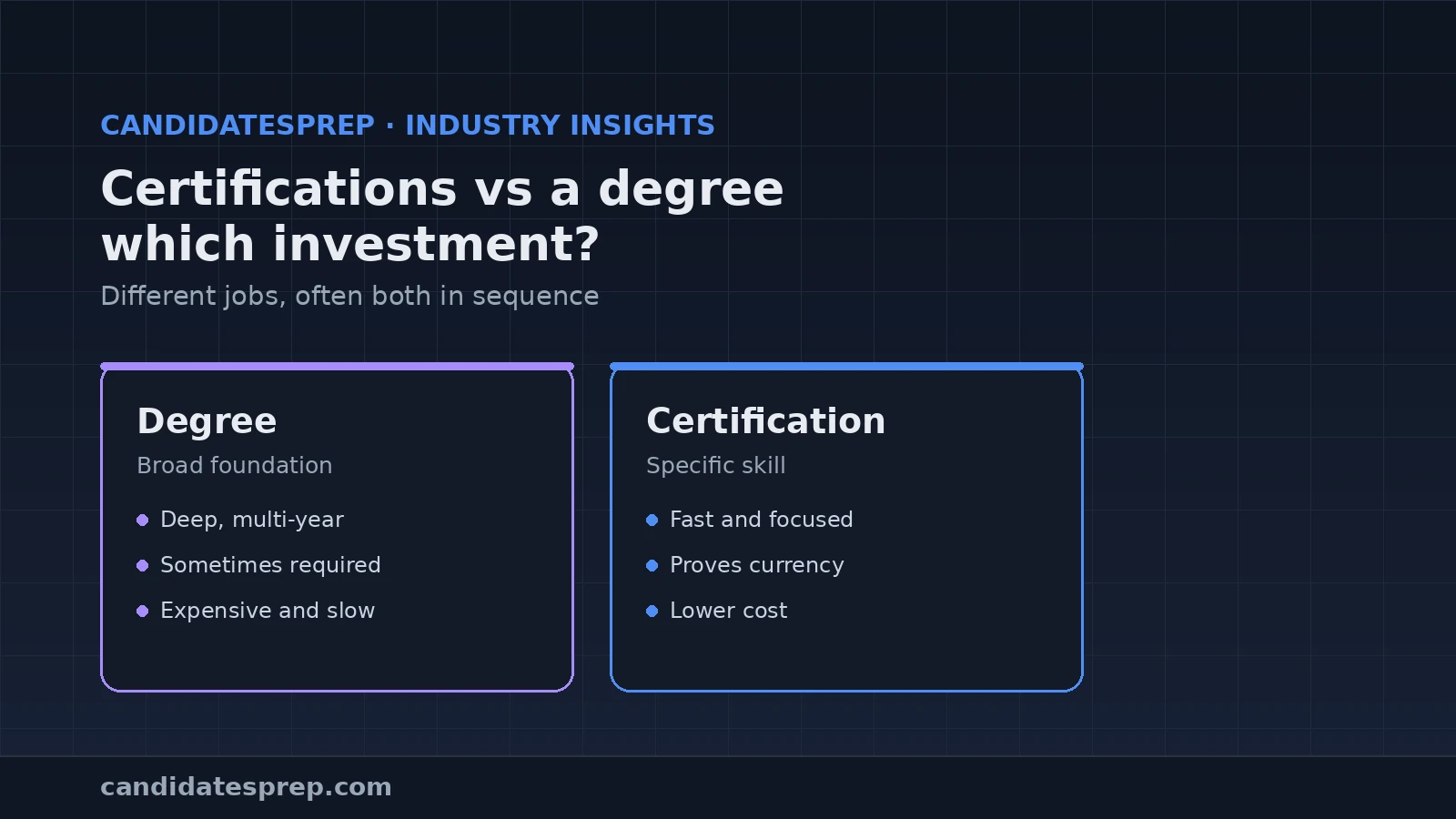
A degree offers broad, deep education over several years, and in many fields it is a baseline expectation or a legal requirement, think medicine, law or engineering. It can open doors that nothing else will, builds a wide foundation, and signals a sustained commitment. The trade-offs are real too: it is expensive, slow, and sometimes broad where you needed something specific.
What a certification is good for
A certification proves a specific, current skill, usually in months rather than years and at a fraction of the cost. In fast-moving fields like IT, cloud, security and project management, a respected certification can carry real weight with employers, sometimes more than an unrelated degree. The trade-off is narrowness: it proves one capability well, not a broad education.
It is often not either or
The framing of degree versus certification is frequently a false choice. Many successful professionals have both: a degree for the foundation, certifications to stay current and specialise. Certifications are also a powerful way to pivot or upskill after a degree, without returning to university for years. Think of them as complementary tools rather than rivals for the same job.
How to decide
- Does your target field or role legally require a degree? If so, that decision is made for you.
- Do you need broad foundational education, or proof of a specific skill? Degrees suit the first, certifications the second.
- How do time and cost weigh for you right now? Certifications are faster and cheaper to earn.
- What do the actual job adverts in your field ask for? Let real listings, not assumptions, guide you.
Weigh the real return
Whichever route you consider, do the sum honestly: the full cost in money and time against the specific doors it opens in your market. A certification nobody values is a poor investment, and so is a degree that does not lead where you want to go. Our guide to calculating the return on a certification applies the same clear-eyed test.
The role of continuous learning
In a changing economy, neither a degree nor a single certification is a finish line. The professionals who thrive keep learning throughout their careers, adding credentials as fields evolve. Whatever you choose now, treat it as one step in a longer habit of staying current rather than a once-and-done decision.
Practise under real exam conditions
If a certification is part of your plan, preparation is what protects the investment. CandidatesPrep gives you timed, domain-scored mocks so you pass with confidence rather than paying the cost twice. Trainers can build certification into a team's development alongside formal education.
The bottom line
Certifications and degrees answer different questions, so the better investment is the one that fits your field, goal and situation, and often the answer is both, in sequence. Decide from real requirements and honest sums, not from the framing of a rivalry that does not really exist.
Making a certification part of your plan? Sit a timed mock on the CandidatesPrep simulator, or book a demo to develop a team.