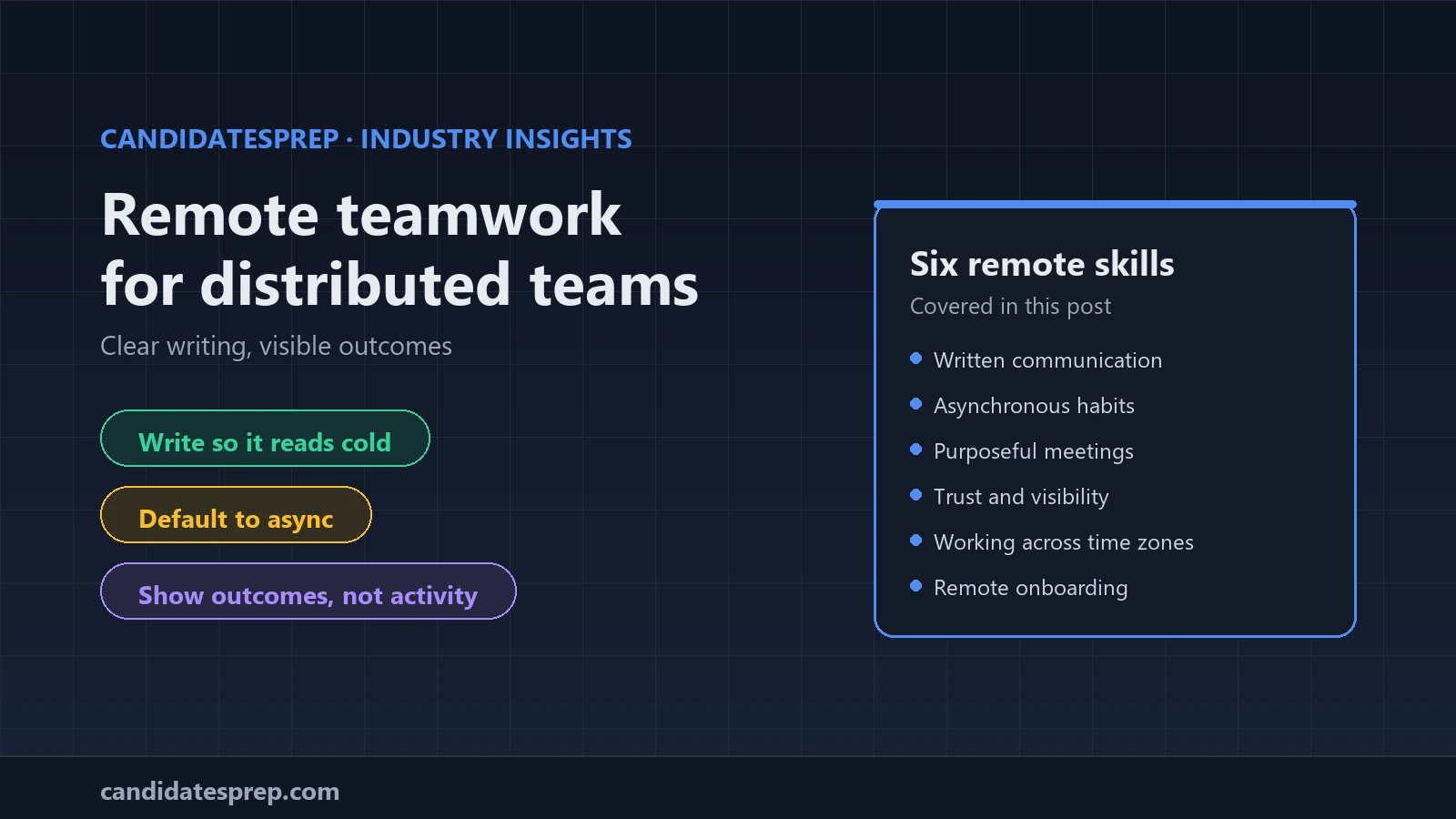
Remote teamwork works when people write clearly, share progress without being asked, keep meetings for real discussion and plan around each other's hours. These habits replace the quick chats and visible effort of an office. None of them is a personality trait: all of them can be learned and practised.
Why distributed teams need different habits
Remote and hybrid work is now routine for many people. The Office for National Statistics found that 28% of working adults in Great Britain hybrid worked between January and March 2025. When a team is spread across homes, offices and countries, the informal glue of office life disappears: no overheard conversations, no quick question across the desk, no noticing who is stuck. The skills below put that glue back on purpose. They build on the human skills in our post on why soft skills are the new hard skills.
Write so it can be read cold
In a distributed team, much of the work happens in writing. A message should make sense to someone reading it hours later, in another time zone, with no chance to ask what you meant.
- Lead with the point or the request.
- Give the context a reader needs, and link to the source rather than retelling it.
- Say what you need, from whom and by when.
- Keep one topic per thread so replies stay together.
Our guide to communication skills covers clear structure in more depth; remote work makes it a daily requirement.
Build asynchronous habits
Asynchronous work means people contribute in their own hours instead of waiting for everyone to be online at once. It depends on a few shared habits:
- Post updates and questions in shared channels, not private messages, so others can find them later.
- Record decisions, and the reasons for them, in one agreed place.
- Agree how quickly each channel needs a reply, so nobody feels they must answer instantly.
- Send the whole question in one message, rather than "Hi, have you got a minute?"
Make meetings earn their place
Meetings cost more when people are spread across hours and screens, so save them for what needs live conversation: difficult discussions, early brainstorming, decisions with many trade-offs, and building relationships. For routine updates, writing usually works better. When you do meet, share an agenda and any reading in advance, finish with decisions and owners written down, and post notes for anyone who could not attend.
Trust and visibility
Distance can make managers anxious. Microsoft's Work Trend Index (September 2022), a survey of more than 20,000 people in 11 countries, reported that 85% of leaders said the shift to hybrid work had made it challenging to have confidence that employees were being productive, while 87% of employees reported that they were productive at work. The answer is visible outcomes, not visible activity.
- Agree priorities with your manager, so you both know what good looks like this month.
- Share a short written update each week: done, next, blocked.
- Flag problems early, while there is still time to help.
- Ask for specific feedback; our guide to giving and receiving feedback shows how.
Working across time zones
- Find the hours of overlap and protect them for work that needs everyone.
- Rotate meeting times so the same people are not always up early or late.
- Write times with the time zone, and set deadlines in one agreed zone.
- End your day with a short handover note: what is done, what is next, and what the next person needs.
- Expect some replies to take a day, and plan work so that is not a problem.
Onboarding someone you cannot sit beside
New joiners pick up much of a team's culture by watching. Remotely, that has to be designed. A good remote onboarding plan includes written guides to tools and ways of working, a named buddy who is not their manager, a first-week plan with a small, achievable task, and short regular check-ins. If you are the one joining, ask where decisions are written down, book short introductions with the people you will work with, and ask questions in shared channels so the answers help the next person too.
Train and assess a distributed team
Distributed teams still need consistent training and proof of competence, which is harder to arrange when nobody shares an office. On CandidatesPrep, organisations can deliver SCORM-compliant courses with video, text and quizzes, set learning paths that unlock in order, and schedule assessments for staff wherever they are, with proctoring when a result needs to be trusted. Every result breaks down by topic, and scheduled reports keep managers informed without chasing. See how this works for corporate learning and development.
The bottom line
Remote teamwork rests on clear writing, asynchronous habits, purposeful meetings and visible outcomes. Practise them deliberately and distance stops being the obstacle; unclear communication usually was.
Try a timed assessment on the CandidatesPrep simulator, or book a demo to train and assess a distributed team.