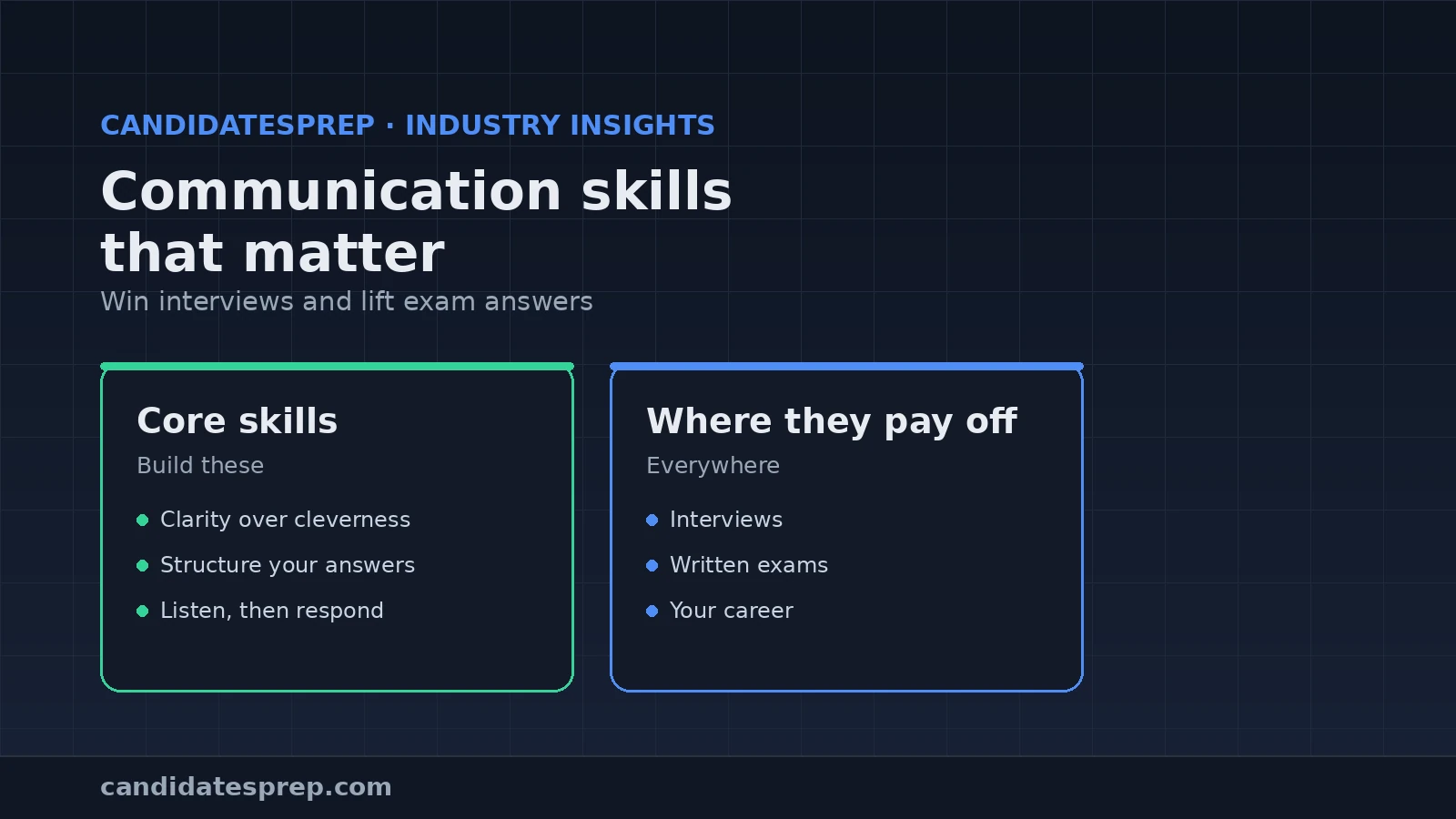
Strong communication is one of the highest-return skills you can build: it wins interviews, lifts written exam answers, and shapes how far you go at work, often more than technical knowledge alone. The good news is that communication is a skill, not a fixed trait, so it can be practised and improved. Here is where to focus.
Clarity beats cleverness
The core of good communication is making yourself easily understood, not sounding impressive. Say one thing at a time, in plain words, and get to the point. In interviews and written exams alike, markers and interviewers reward answers they can follow effortlessly over tangled ones stuffed with jargon. If a simpler word works, use it.
Structure your answers
A well-structured answer is far more persuasive than a rambling one with the same content. Lead with your main point, then support it, then conclude. Simple frameworks help: for interview stories, describe the situation, the task, the action you took and the result. Structure signals clear thinking, and clear thinking is exactly what examiners and employers are looking for.
Listen before you respond
Communication is two-way, and listening is the half people neglect. In an interview, answer the question actually asked, not the one you prepared for. Pausing to understand before you reply makes your response land, prevents you talking past the other person, and signals the kind of attentiveness that strong teams value.
Write clearly
Much of professional and academic communication is written, from exam essays to work emails. Short sentences, a logical order, and a clear first line do most of the work. If you can state your point in the opening line and let the rest support it, your writing will read as confident and competent, on an exam script or in an inbox.
Adapt to your audience
Good communicators pitch the same message differently for different people, explaining to a beginner in one way and to an expert in another. In interviews, that means reading the room and matching your level of detail to who is asking. This flexibility is a mark of real understanding, since you can only simplify well what you genuinely grasp.
How to build it
- Practise explaining topics out loud from memory, which sharpens both understanding and delivery.
- Do mock interviews and ask for honest feedback on clarity and structure.
- Write regularly and reread it ruthlessly, cutting anything that does not earn its place.
- Join a study group, where teaching peers forces you to communicate clearly.
Where exams fit
Many professional exams test communication directly, through written answers or scenario questions, and all of them reward clear thinking. Being able to structure a response under time pressure is a learnable exam skill in its own right, and it transfers straight to interviews and work.
The bottom line
Communicate clearly, structure your answers, listen properly, write plainly, and adapt to your audience. These skills lift your interviews, your exam answers and your career together, and every one of them improves with deliberate practice.
Sharpen how you perform under pressure: sit a timed mock on the CandidatesPrep simulator, or book a demo to build these skills across a team.