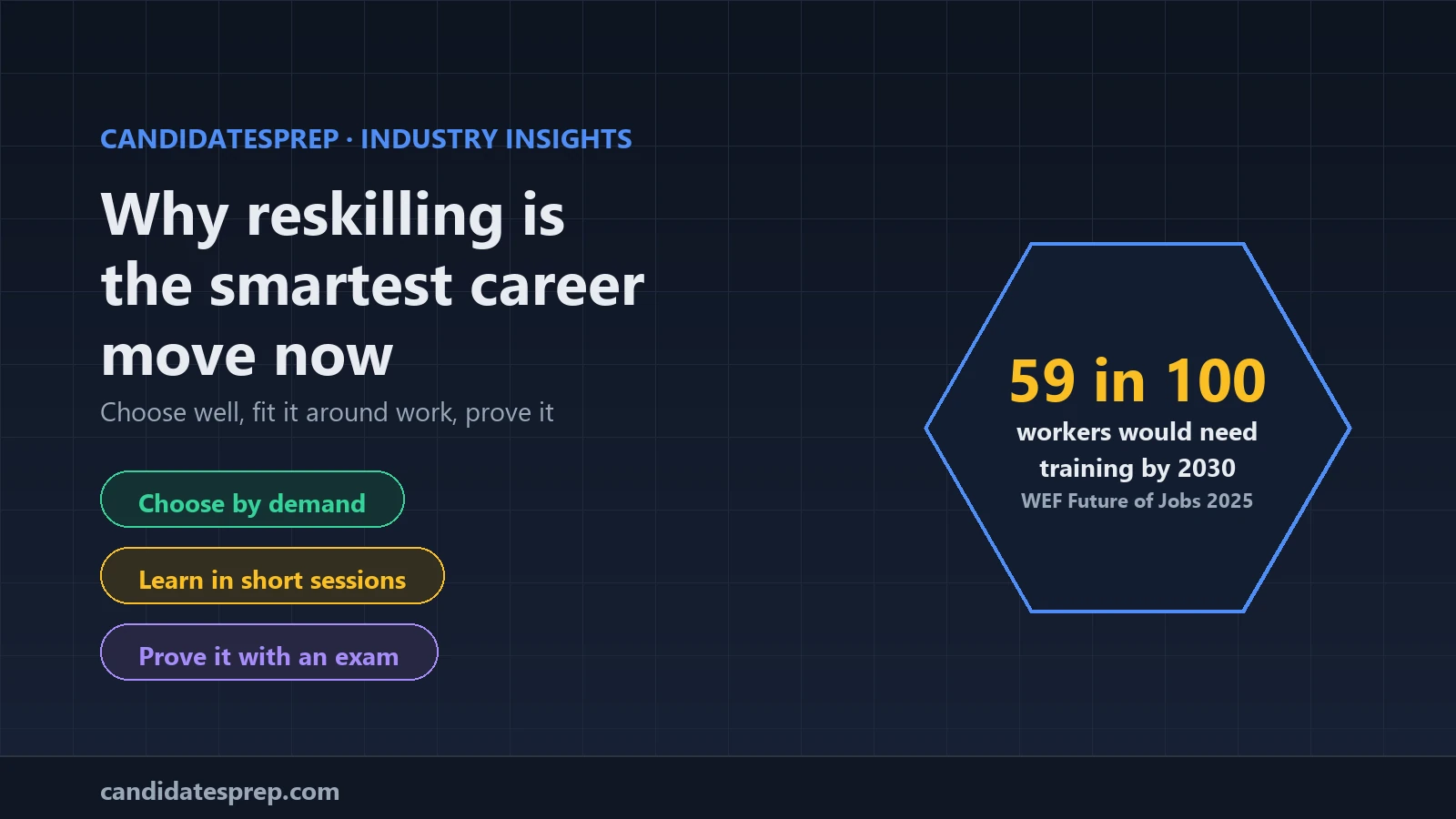
Reskilling is the smartest career move now because the skills employers want are changing fast, while adult learning has stalled in many countries. The World Economic Forum's Future of Jobs Report 2025 found that employers expect 39% of workers' core skills to change by 2030. Here is how to choose what to learn and fit it around work.
The case for reskilling
Upskilling deepens the skills you use in your current role; reskilling builds skills for a different one. Both are now routine. In the Future of Jobs Report 2025, employers estimate that if the world's workforce were 100 people, 59 would need training by 2030. They expect 29 to be upskilled in their current roles and 19 to be reskilled and redeployed, but 11 would be unlikely to receive the training they need.
Employers are investing: 85% plan to prioritise upskilling their workforce, and they report that 50% of their workforce has completed training, up from 41% in the 2023 edition. Yet the OECD's Trends in Adult Learning report (2025) found that only around 40% of adults in OECD countries take part in learning each year, and that participation appears to be falling in many countries. Waiting to be chosen for training is a risk. Choosing it yourself puts you ahead.
Our guide to recession-proof skills explains why adaptability is the best career insurance. Reskilling is how you put that into practice.
How to choose what to learn
Start from demand, then narrow down to what suits you.
- Check the growth list. The WEF names AI and big data, networks and cybersecurity, and technological literacy as the fastest-growing skills, with creative thinking, resilience, flexibility and agility, and curiosity and lifelong learning rising alongside them.
- Stay close to home. The easiest move builds on what you already know. A finance professional adding data analysis, for example, starts with context that someone switching fields entirely does not have.
- Read real job adverts. Look at roles you want in two years and note the skills and certifications they ask for repeatedly.
- Choose depth over a pile of short courses. The OECD found that 42% of non-formal job-related learning activities last one day or less, and suggests modular pathways and stackable qualifications to turn short courses into meaningful skill gains over time.
How to fit it around work
Time is the main obstacle. The OECD found that one in four adults met a barrier to learning in the previous 12 months, most often lack of time because of work or family, and cost.
- Book small, fixed slots. Three or four short sessions a week on the calendar beat a vague plan for a long weekend.
- Set a deadline. A booked exam date turns good intentions into a schedule.
- Ask your employer. The OECD notes that employer support is one of the strongest predictors of taking part, and most training happens at work. Link your learning to your current role and the case is easier to make.
- Review in spare moments. Short recall sessions on a commute keep material fresh between proper study blocks.
Our guide to time management for exam prep has more on building a routine that lasts.
Where certifications fit
A certification turns learning into something an employer can check. Be realistic about what it does, though. In the WEF report, 81% of employers expect to keep relying on work experience in hiring and 48% expect to use skills assessments, while only 14% plan to consider online certificates. The lesson is that a credential counts most when it rests on a properly assessed exam and on skills you can demonstrate.
So pair a recognised certification with hands-on practice, and choose one that your target roles actually ask for. Our guide to whether certifications are worth it shows how to weigh the cost against the likely payoff.
For employers: reskilling at scale
For organisations, the risk is training that looks busy but changes little. The OECD found that much adult training is compliance or safety driven and short, which may not meet the reskilling needs of fast-changing jobs. A corporate training LMS helps when it pairs structured learning paths with assessments, so you can see which skills have actually moved.
Practise under real exam conditions
Whatever you learn, the exam is where it becomes proof. On CandidatesPrep you can sit timed mocks that mirror the real exam's timer, navigation and flagging, then see your results broken down by topic, so limited study time goes to your weakest areas. The installable app works offline for practice, which helps when your study slots are on a train. For teams, courses sit in learning paths that unlock in order, and certificates are issued automatically and can be verified publicly by code.
The bottom line
Skills are changing fast and adult learning is not keeping pace in many countries, so reskilling on your own initiative is one of the surest ways to stay employable. Choose by demand, learn in small regular sessions, and finish with proof an employer can trust.
Start with a timed mock on the CandidatesPrep simulator, or book a demo to plan reskilling for your team.