PSM II is worth it if you already work as a Scrum Master and want proof that you can apply Scrum to messy, real situations, not just recite the Scrum Guide. It costs $250 against PSM I's $200, gives you 90 minutes for 30 questions and needs the same 85%. If you are new to Scrum, start with PSM I.
The two exams side by side
Both are online assessments from Scrum.org, and the headline numbers tell you a lot:
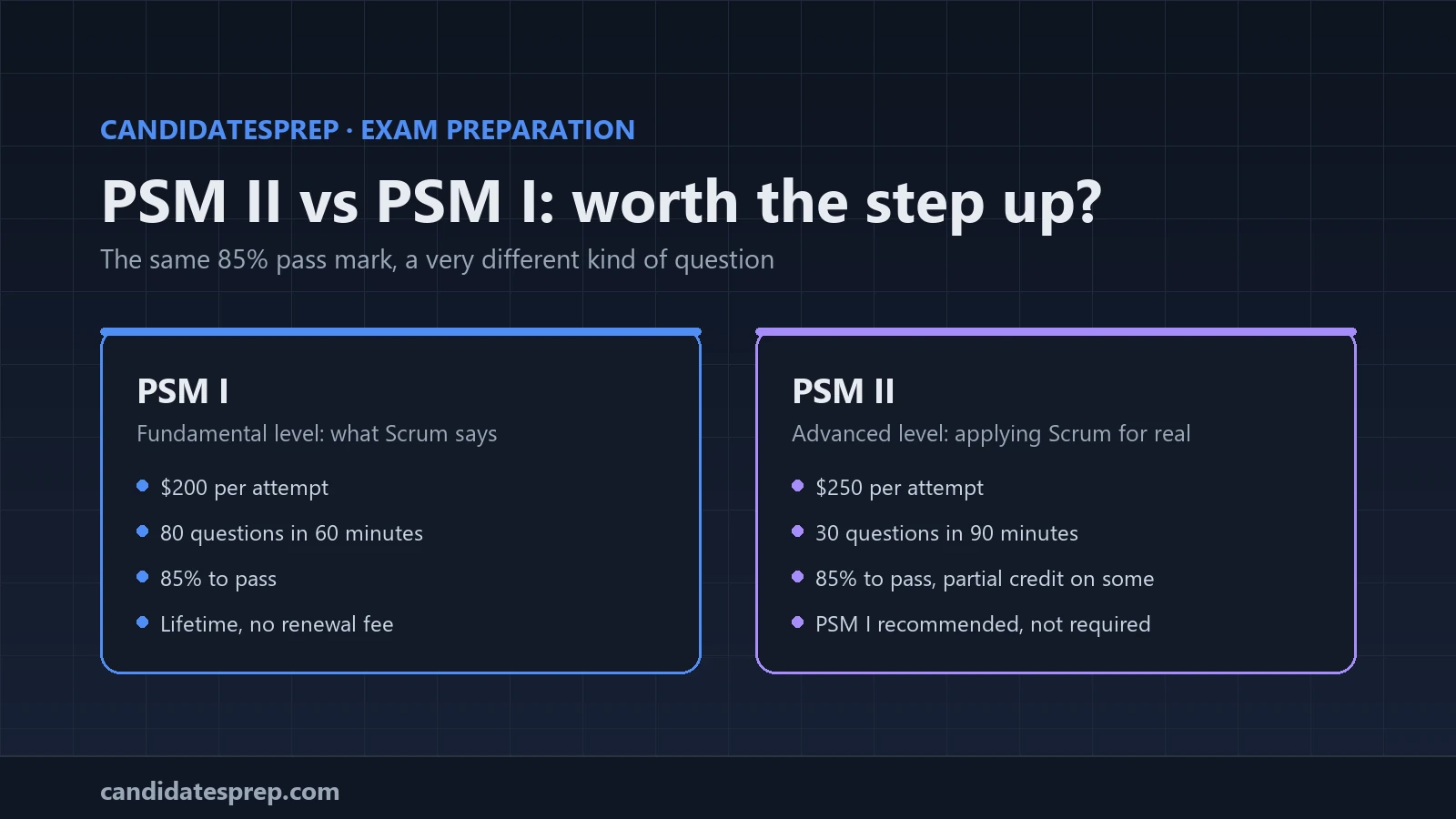
- PSM I: $200 per attempt, 80 questions, 60 minutes, 85% to pass. Multiple choice, multiple answer and true or false. Available in English and Japanese, and in Simplified Chinese through scrum.org.cn.
- PSM II: $250 per attempt, 30 questions with partial credit on some, 90 minutes, 85% to pass. The same question types. Available in English, and in Simplified Chinese through scrum.org.cn.
They share the rest of the rules. Neither requires a course, though Scrum.org strongly recommends one. Each password is valid for one attempt but never expires. Both are lifetime certifications with no annual renewal fee, and both come with a free Credly digital credential. Scrum.org lists PSM I as the recommended certification before PSM II, but it is not a prerequisite. Taxes may be added at checkout, so check the official PSM II page for current details.
What PSM II tests that PSM I does not
Scrum.org describes PSM I as proof of "a fundamental level of Scrum mastery": you understand Scrum as the Scrum Guide describes it and how to apply it in Scrum Teams. PSM II is pitched at an advanced level, and Scrum.org says candidates should have "in-depth Scrum Master experience".
The focus areas show the shift. PSM I draws on the Scrum framework itself, on developing people and teams through self-management, facilitation and coaching, and on managing products, including forecasting, product value and backlog management. PSM II keeps the framework and the people side, adds leadership styles and mentoring to it, and brings in managing technical risk and organisational design and culture. In short, PSM I asks what Scrum says; PSM II asks what a good Scrum Master would do next.
Is it harder?
Yes, but differently. PSM I gives you 45 seconds per question, so it rewards fast, precise recall: a single changed word in a question can change the answer, and you have little time to reread. PSM II gives you three minutes per question. The difficulty is judgement. Scrum.org frames it around applying Scrum in complex, real-world situations, so several options can sound reasonable, and you must pick the one most consistent with Scrum's values and empiricism rather than the one that sounds familiar from work.
The pass mark does not soften either. At 85% of 30 questions there is room for only a handful of mistakes, though partial credit on some questions helps. After either attempt you see a breakdown of your performance by competency, not which questions you got wrong.
What it costs, and how to pay less
Sitting both at full price comes to $450, before any resits, since every attempt is paid separately. Each Scrum.org class includes a free attempt at its certification. The two-day Professional Scrum Master Advanced course, previously called Professional Scrum Master II, includes a PSM II password; if you use it within 14 days and score below 85%, you get a second attempt at no extra cost, plus a 40% discount on PSM III. Course prices vary by trainer, so compare them yourself.
There is no renewal cost later, which is one of the clearest differences from the Scrum Alliance route covered in our PSM vs CSM comparison.
Who actually benefits
The step up makes most sense for:
- Scrum Masters with a year or more of experience, which is who Scrum.org designed the advanced course for.
- Anyone moving into coaching or supporting several teams, where the leadership and organisational topics matter.
- People aiming for PSM III, a $500 assessment of 24 essay questions in 150 minutes, graded by Scrum experts.
It makes less sense if you are new to the role, if an employer simply asks for "a Scrum certification", or if your work is really about the product rather than the team. In that last case, our guide to PSM vs PSPO will point you to the better track.
Practise under real exam conditions
The two exams need different rehearsal. For PSM I, drill pace until 80 questions in an hour feels routine. For PSM II, practise slowing down: read each situation twice, rule out the options that break a Scrum rule, then choose between the rest. Scrum.org's free Scrum Open checks the basics first. On CandidatesPrep you can sit timed mocks that mirror the real exam's timer, navigation and flagging, then see your results broken down by topic, so you know whether coaching, stakeholders or technical risk is costing you marks.
The bottom line
PSM I proves you know Scrum; PSM II proves you can use it when the situation is messy. If you have real Scrum Master experience, the extra $250 and the lifetime credential are a sound step; if not, master PSM I first.
Rehearse under a real timer on the CandidatesPrep simulator, or book a demo to run Scrum mocks for a whole team.