Yes, for most revision, as long as you use more than the timer. The Pomodoro Technique helps exam prep when you plan each block, keep it free of interruptions and review what you got done. It suits question practice and review, but it gets in the way of deep problem-solving and full-length mocks. Here is how to use it.
What the technique actually is
Francesco Cirillo began developing the Pomodoro Technique in the 1980s, when he was a university student struggling to concentrate. He challenged himself to focus for a short stretch using a tomato-shaped kitchen timer, and the method takes its name from it: pomodoro is Italian for tomato. The version most people know is 25 minutes of focus on one task, then a short break, with a longer break after a few rounds.
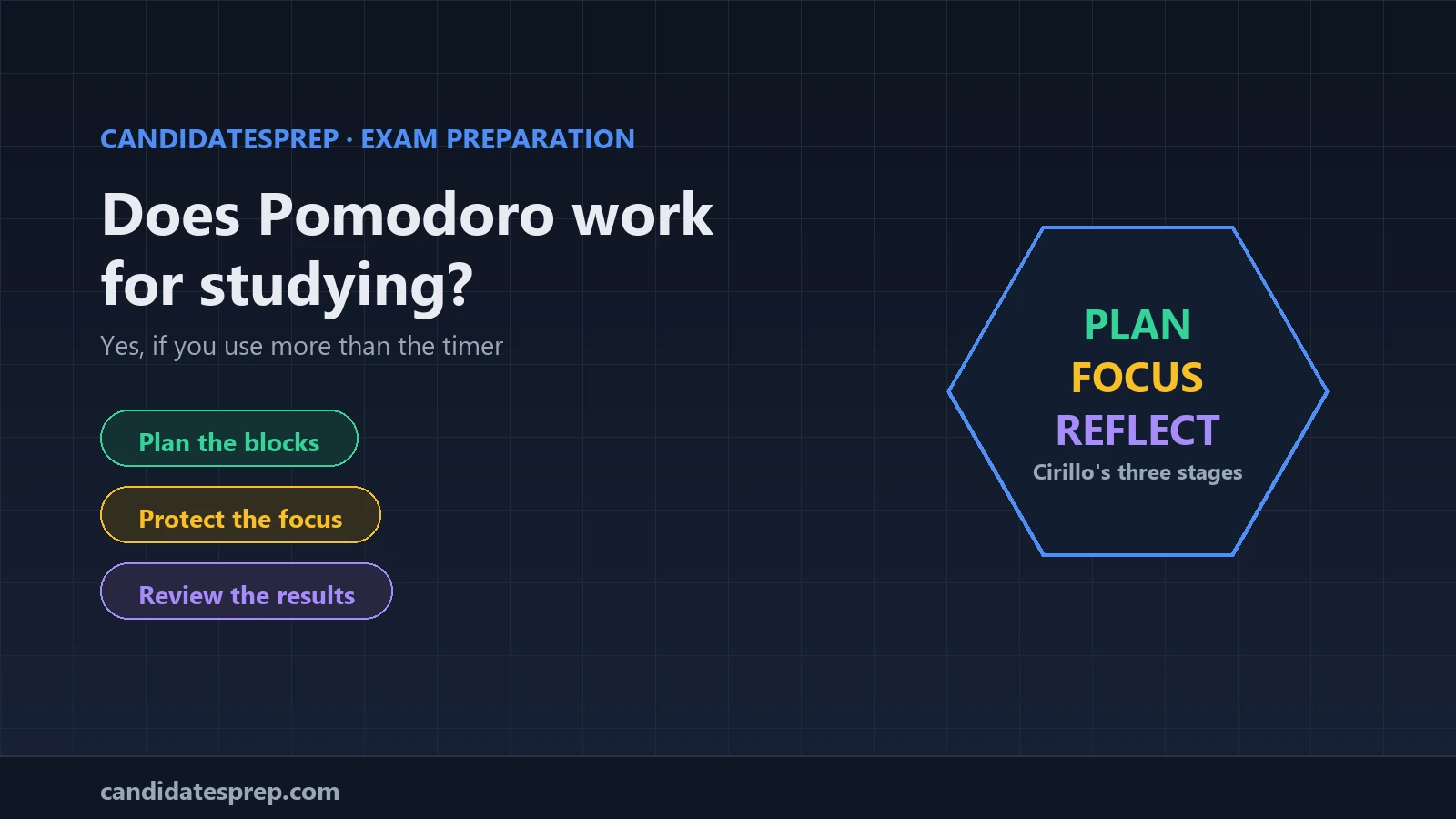
Cirillo is clear that the timer is only one piece. His official Pomodoro Technique site describes three stages: plan your work and estimate the effort, focus on one activity at a time while handling interruptions and taking regular breaks, then reflect by recording your effort against your estimates. Check the site for the full method and current materials. Most people skip planning and reflecting, yet for exam prep they are the most useful parts.
Does it work? Keep expectations modest
There is less hard evidence than its popularity suggests. One relevant study, published in the British Journal of Educational Psychology in 2023, followed 87 university students through a day of their own study. Students given fixed breaks (one group took 6 minutes after every 24 minutes) reported less fatigue and more concentration and motivation than students who chose their own breaks, and completed about the same amount of work.
That is encouraging, but it was one day at one university, and it measured how students felt and how much they finished, not exam results. Scheduled breaks may make long study days easier to sustain; your score still depends on what you do inside each block.
How to use it for exam prep
- Plan in Pomodoros. Each evening, list tomorrow's tasks and estimate the blocks each needs, for example two Pomodoros on 20 practice questions and one on reviewing every wrong answer.
- Give each block one finishable job. "Revise networking" invites drifting; "answer and check 12 subnetting questions" does not.
- Spend breaks away from the screen. Stand up, stretch, get water. Scrolling your phone pulls your attention elsewhere rather than resting it.
- Park interruptions. Write stray thoughts on a notepad and deal with them in the break.
- Reflect at the end of the day. Compare the Pomodoros each task took with your estimate. Topics that keep overrunning are usually your weak ones, so tomorrow's blocks go there.
If you struggle to start at all, our guide to beating procrastination deals with that first. For fitting study slots into your week, see time management for exam prep; Pomodoros are the unit you use inside those slots.
When to put the timer away
Two kinds of exam prep work against the rhythm.
Deep problem-solving. A long calculation, a case study, a configuration lab or an essay plan can take a while just to load into your head, and a bell at minute 25 can throw that away. Let the block run to a natural stopping point, or switch to longer blocks.
Long mocks. A full-length practice exam should run on the real exam's clock, with only the breaks the real exam allows. Chopping a three-hour mock into 25-minute pieces trains the wrong stamina and hides pacing problems. Treat the whole mock as one block and rest properly afterwards.
Cirillo's own site says the 25-minute sessions are not the core of the technique, so adapting them is fair.
Variations worth trying
- Longer blocks for heavy work. Fifty minutes of focus and a ten-minute break suits calculation-heavy subjects and writing practice.
- Shorter blocks on low-energy days. Ten or fifteen minutes is enough to get moving.
- Flexible blocks. Work until your focus dips, then take a break. Set an upper limit, though: in the 2023 study, students who chose their own breaks drifted into longer sessions and longer breaks, and reported more fatigue.
- Shared blocks. Study partners can run one timer, work in silence and quiz each other in the breaks. See our guide to running a study group.
- Exam-paced blocks. Late in your preparation, set a block's target to the exam's pace, such as the questions you would need to answer in 25 minutes on the day.
Practise under real exam conditions
Pomodoros are for learning; mocks are for rehearsal. On CandidatesPrep you can sit timed mocks that mirror the real exam's timer, navigation and flagging, then see your results broken down by topic. Those results sharpen your planning: the weakest topics get the most Pomodoros next day, and the next mock shows whether that worked.
The bottom line
The Pomodoro Technique works for studying when you use all of it: plan the blocks, protect them and review what they produced. Keep it for question practice and review, and set it aside for deep problem-solving and full mocks.
Find out where your Pomodoros should go with a timed mock on the CandidatesPrep simulator, or book a demo to set up structured practice for a whole cohort.