Procrastination before an exam is rarely laziness; it is usually your brain avoiding the discomfort of a task that feels hard, dull or threatening. The fix is to make starting easy rather than to wait for motivation. Motivation tends to follow action, not precede it. Here is how to get moving and keep going.
Understand what is really happening
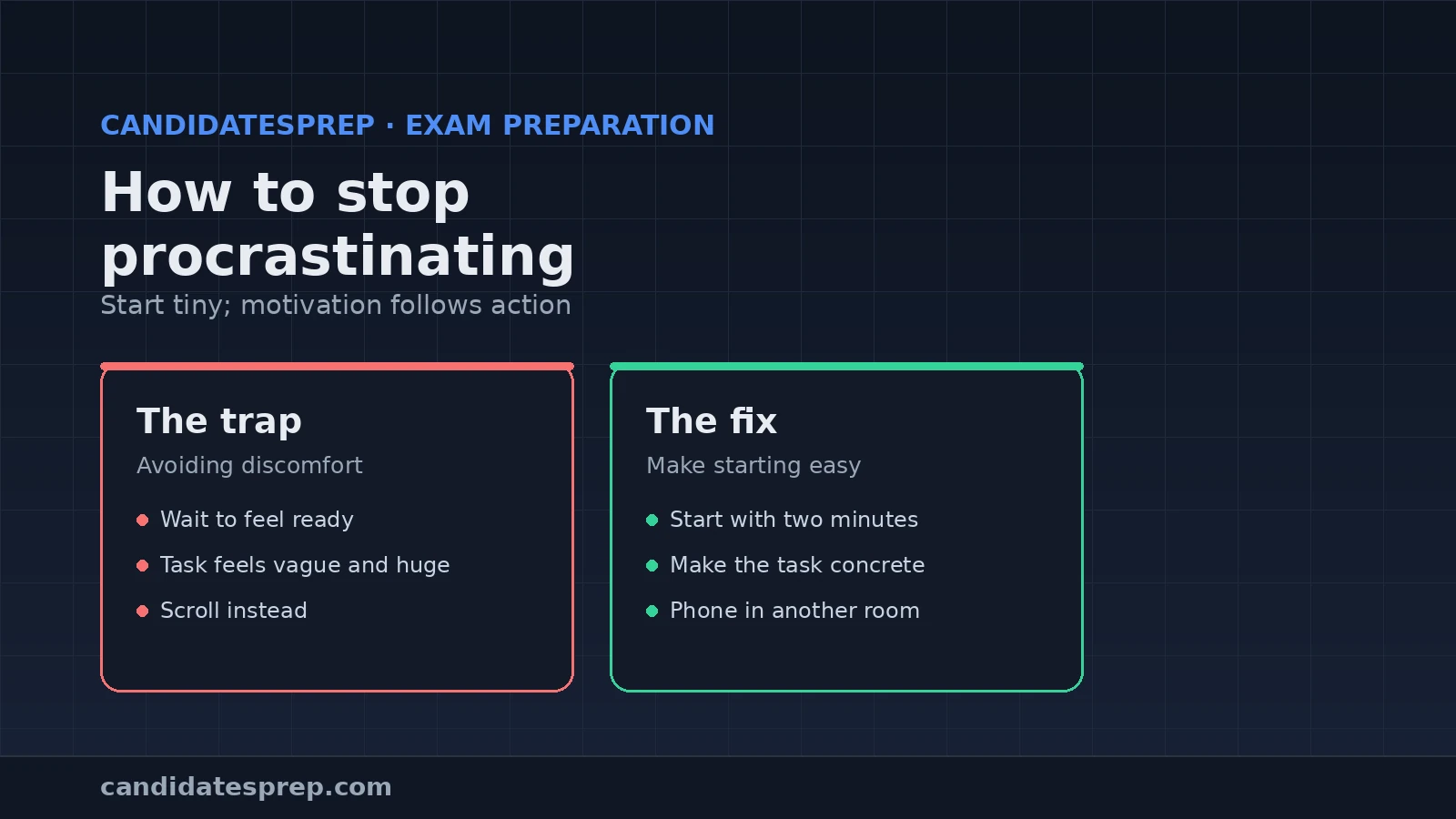
When you put off studying, you are usually dodging a feeling, not the work itself: the fear of finding out you do not understand something, or the dullness of a big vague task. Naming that honestly helps, because the solution is not to scold yourself into working but to lower the barrier to starting. Self-criticism tends to make avoidance worse, not better.
Shrink the first step
The hardest moment is the start, so make it tiny. Commit to just two minutes or a single practice question, not a three-hour session. Once you have begun, continuing is far easier than starting, and you will often carry on well past the tiny commitment. The goal is simply to break the standstill.
Make the task concrete
"Revise for the exam" is too big and vague to begin, so it gets postponed. "Do ten practice questions on domain three" is specific and finishable. Break your revision into small, concrete actions with a clear finish line, and procrastination loses much of its grip. A good study timetable does a lot of this work for you by naming the next action.
Remove the friction and the distractions
Make starting easy and stopping hard. Have your materials open and ready the night before, so there is nothing to set up. Then put your phone in another room during focused blocks; willpower loses to a notification every time. You are not weak for being distracted by a device engineered to distract you, so design the temptation out.
Use the clock as a tool
Short, timed blocks turn an open-ended slog into a manageable sprint. Tell yourself you will work for 25 minutes and then stop, and the task feels survivable. Techniques built on focused intervals with breaks work precisely because they make starting low-stakes and give your attention a rhythm.
Be kind to yourself about slips
You will miss sessions; everyone does. The candidates who succeed are not the ones who never slip, but the ones who do not let one missed session become a lost week. Treat a slip as a single data point, start the next tiny step, and move on. Guilt is not a study technique.
Practise under real exam conditions
Nothing cuts through avoidance like a timed mock, because it gives you an immediate, concrete task with a clear end. CandidatesPrep mocks are scored by domain, so each sitting hands you a specific, finishable next action rather than a vague mountain. Trainers can use shared mocks to keep a cohort moving.
The bottom line
Stop waiting to feel ready. Shrink the first step, make the task concrete, remove distractions, use the clock, and forgive your slips. Start tiny, and momentum does the rest.
Break the standstill now: sit a timed mock on the CandidatesPrep simulator, or book a demo to keep a cohort on track.