When the choice is one more hour of revision or an hour of sleep, sleep usually wins. A late hour on a tired brain is rarely good study, and the lost sleep can cost you attention and memory the next day. Here is what official guidance says, what sleep does for learning, and how to stop the late hour happening.
The real trade-off
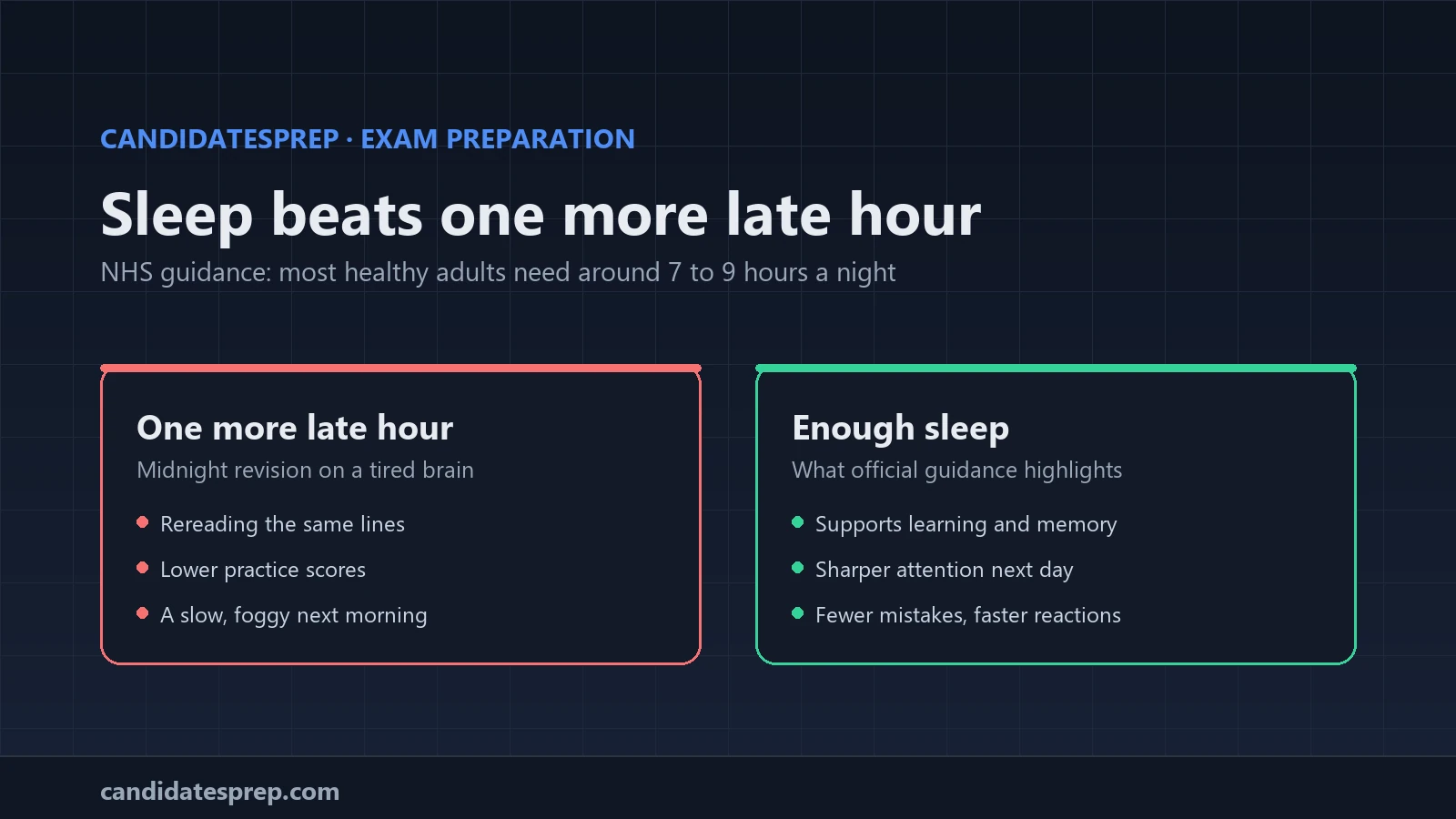
An hour at midnight is not the same as an hour at ten in the morning, and you pay for it twice: the late hour itself is poor quality, and tomorrow's study suffers from the sleep you gave up. You can usually tell when it is happening:
- You reread the same lines without taking them in.
- Your evening practice scores are noticeably lower than your daytime ones.
- You need more caffeine to keep going, then struggle to fall asleep.
- Your next morning's session is slow and foggy, so the time you "gained" is lost again.
So the honest comparison is not "one more hour of study versus nothing". It is a weak hour tonight against a sharper day tomorrow, and over a long exam prep those days add up.
How much sleep adults need
Official guidance is consistent. The NHS says most healthy adults need around 7 to 9 hours a night, although the exact amount varies from person to person. The CDC recommends 7 or more hours a night for adults aged 18 to 60.
Work backwards from your alarm. If you need to be up at 7am and want around eight hours, lights out is 11pm. The NHS also suggests relaxing for at least an hour before bed, which puts the end of your last study session nearer 10pm. Plan your evening around that, not around how much is left on your list.
What sleep does for learning
Claims about sleep and memory are easy to overstate, so it is worth sticking to what official health bodies say. The US National Heart, Lung, and Blood Institute explains that while you sleep, your brain forms new pathways that help you learn and remember, and that studies show a good night's sleep improves learning and problem-solving. Without enough sleep, it says, you may have trouble making decisions, solving problems and remembering things, and you may react more slowly and make more mistakes. The CDC lists better attention and memory among the benefits of enough sleep.
That is exactly the toolkit an exam tests: recall, careful reading and decisions under time pressure. A late hour that chips away at all three is an expensive way to cover one more topic.
How to stop studying on time
- Move the hard work earlier. Put new material and timed practice in your sharpest hours, and keep evenings for light review.
- Set a finish time and a wind-down. A study timetable that works ends at a set hour, not when you feel you have done enough.
- Park unfinished work. Write tomorrow's first task on paper so you can let go of it tonight.
- Watch the caffeine. The NHS advises not drinking alcohol, tea or coffee for at least 6 hours before bed.
- Keep regular times. NHS advice is to go to bed and wake up at around the same time each day, and that includes the days before your exam.
If the late nights come from leaving work too late, our guide to cramming vs spaced study shows how to spread it out instead.
When sleep problems need more than a routine
Poor sleep is also one of the early warning signs of exhaustion on a long prep, which our guide to avoiding study burnout covers. If changing your habits has not helped, you have had trouble sleeping for months, or poor sleep is making it hard to cope day to day, the NHS advises speaking to a GP.
Practise under real exam conditions
Do your most demanding practice when you are rested, ideally at the time of day your real exam starts. On CandidatesPrep you can sit timed mocks that mirror the real exam's timer, navigation and flagging, then see your results broken down by topic. Knowing exactly which topics need work lets you spend your sharp daytime hours on them, rather than chasing vague worries late at night.
The bottom line
One more late hour feels productive but usually buys little and costs you the next day. Protect your sleep, move demanding work earlier and stop at a set time.
Put your rested hours to work with a timed mock on the CandidatesPrep simulator, or book a demo to plan a cohort's preparation at a sustainable pace.