Spaced study beats cramming for anything you need to remember beyond the next day: spreading the same hours across several sessions leaves you knowing more on exam day and long after it. Cramming can lift a score in the short term, but most of it fades quickly. Here is why, and how to space your study even when time is short.
What cramming actually does
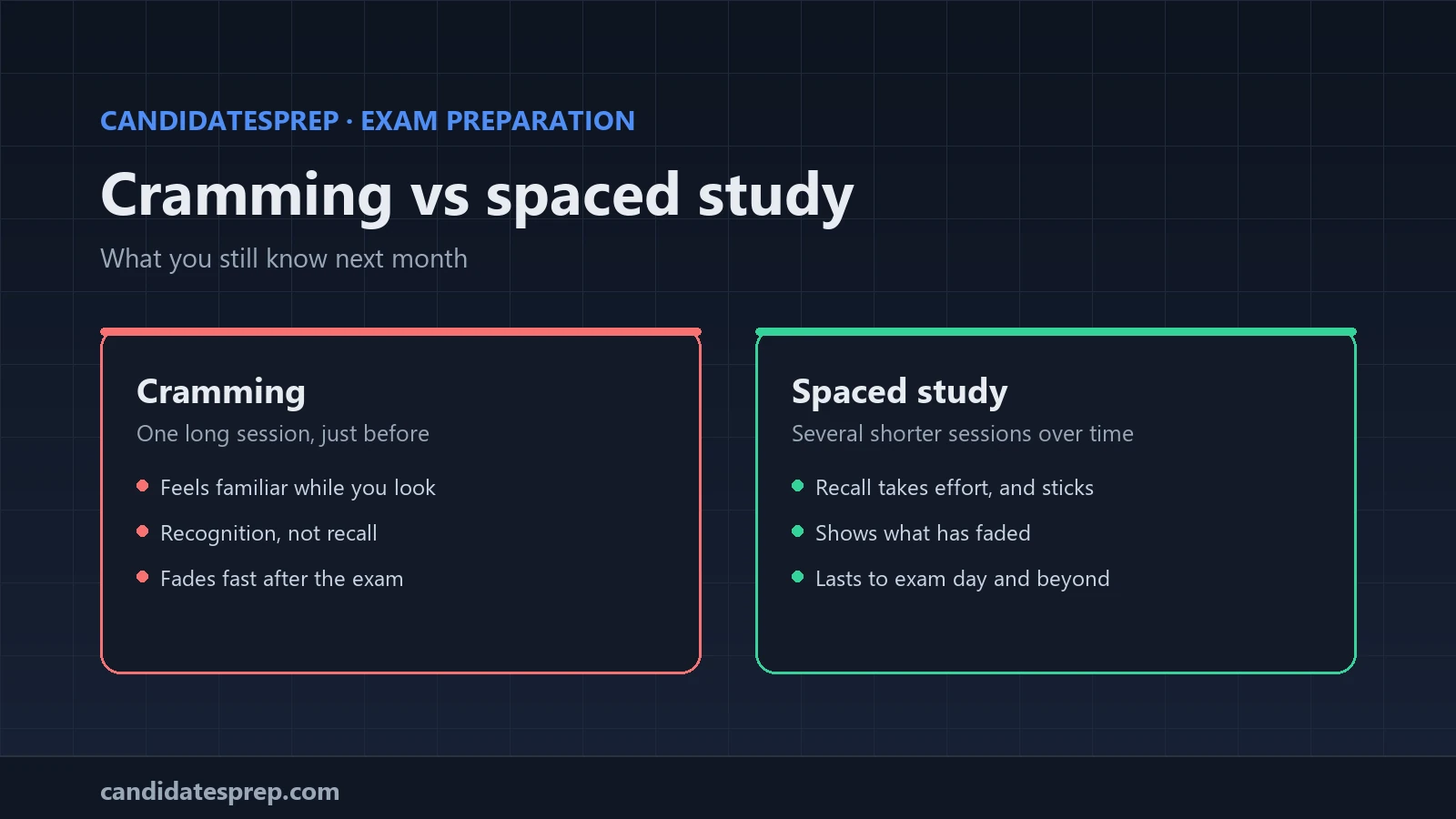
Cramming, or massed practice, packs a lot of study into one long session, usually just before the exam. It feels effective because the material is fresh and familiar while you are looking at it. That familiarity is the trap: recognising something on the page is not the same as recalling it under pressure, and what you crammed tends to fade fast once the session ends. If the exam is the next morning, some of it survives. If it is a week away, or you need the knowledge at work, much of it does not.
What the evidence says
Researchers have studied spacing for well over a century. A major 2013 review of learning techniques by John Dunlosky and colleagues, published in Psychological Science in the Public Interest, gave its highest utility rating to just two techniques: distributed practice, meaning spreading study out over time, and practice testing. Rereading and highlighting, the staples of most cramming sessions, were rated low. The Association for Psychological Science summary explains the findings in plain terms.
Why spacing works
When you come back to a topic after a gap, you have partly forgotten it, so recalling it takes effort. That effort is what strengthens the memory. Each spaced session also tells you honestly what has stuck and what has not, which cramming never does. Our guide to spaced repetition explains the forgetting curve and a simple review schedule.
How to space study when time is short
You do not need months. Even with two weeks, you can space your study:
- Split the syllabus so every topic gets a first pass early, not in the final days.
- Revisit each topic at least two or three times, with a gap of a few days between visits.
- Make each revisit a test, not a reread: questions first, notes only to check. Our guide to active recall shows how.
- Mix topics within a session rather than finishing one completely before starting the next.
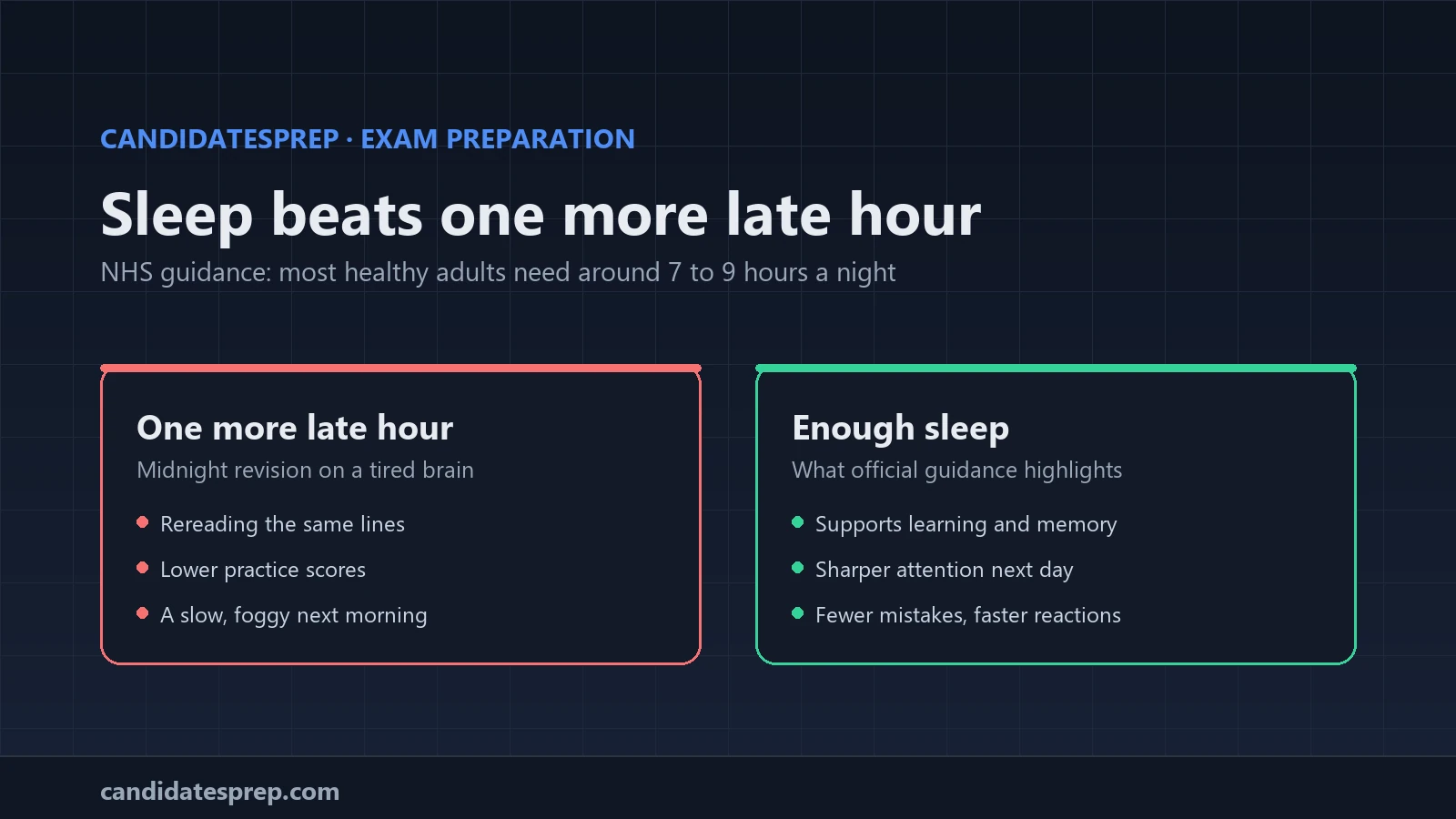
If your exam is closer than that, prioritise the topics your practice results say are weakest, and still split your time into several shorter sessions with sleep in between, rather than one all-nighter.
Is a final review the same as cramming?
No. A short, calm look over a summary sheet the day before is fine, and it works best when the material is already well learned through earlier, spaced sessions. The problem is not looking at your notes late; it is meeting material for the first time late, or relying on one marathon session instead of several shorter ones. For the evening before, protect your sleep, as our guide to exam-day nerves explains.
Why this matters for professionals and teams
For a professional certificate, passing is only half the point. Knowledge that fades a week after the exam is no use on the job, and it makes the next renewal feel like starting again. Teams that run short, spaced refreshers between certifications keep skills current and turn renewal into a check rather than a scramble. This matters most where the knowledge is safety-critical, as our guide to well control training describes.
Practise under real exam conditions
Timed mocks spaced through your preparation are spaced practice at full scale: each one reviews everything at once and shows what has faded. On CandidatesPrep, results break down by topic, so you know which areas to revisit sooner. Trainers can schedule mocks at intervals across a cohort and use learning paths that unlock in order to keep refreshers on a steady rhythm.
The bottom line
Cramming borrows a little short-term recall and pays it back with interest. Spacing the same hours across several sessions, and testing yourself each time, leaves you knowing more on exam day and long after it.
Space out your practice with timed mocks on the CandidatesPrep simulator, or book a demo to set up spaced refreshers for your team.