Spaced repetition means reviewing what you are learning at increasing intervals, timed to catch you just before you forget. It is one of the most efficient ways to move knowledge into long-term memory. Instead of cramming everything at once, you revisit each topic a few times over days and weeks. Here is why that works and how to schedule it without a complicated system.
Why spacing beats cramming
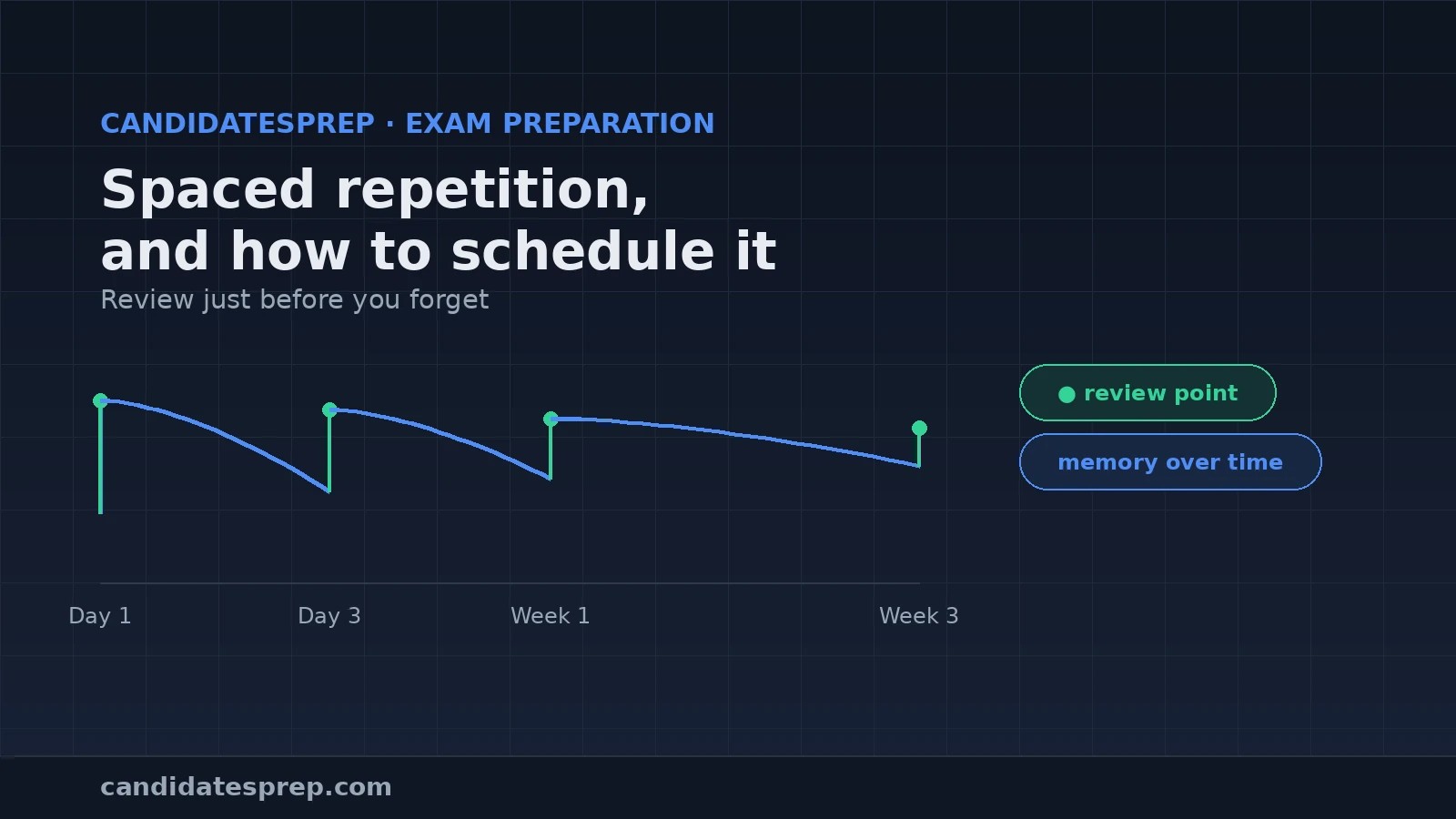
Memory fades on a predictable curve: learn something today and much of it slips away within days if you never revisit it. Each time you successfully recall a fact after nearly forgetting it, the forgetting slows and the memory lasts longer. Cramming crams a lot in briefly, then most of it leaks away. Spacing the same total study time across several sessions keeps far more of it for exam day.
The forgetting curve, in plain terms
The idea goes back to early memory research: without review, retention drops sharply and then levels off. Well-timed reviews flatten that curve, so each topic sits higher in memory for longer. You are not studying more; you are studying at better moments, which is why spaced repetition feels almost like getting extra retention for free.
A simple schedule you can keep
You do not need software to start. A workable pattern for each new topic is:
- Review it the next day.
- Again after about three days.
- Again after a week.
- Again after two to three weeks.
Push the interval out each time you recall it comfortably, and shorten it for anything you stumble on. The exact numbers matter less than the principle: growing gaps, driven by how well you actually remember.
Pair it with active recall
Spacing decides when you review; active recall decides how. The two are far stronger together than either alone. When a topic comes up for review, do not re-read it. Close the notes and try to retrieve it, then check. A spaced schedule built on retrieval, rather than re-reading, is the core of efficient revision.
Fit it to your exam timetable
Spaced repetition works beautifully alongside a plan built backwards from your exam date. Introduce topics early enough that each one gets several spaced reviews before the exam, rather than meeting some subjects for the first time in the final week. Our guide to building a study timetable shows how to lay that out across the weeks you have.
Practise under real exam conditions
Timed mocks are spaced repetition at the level of whole domains. Sit them at intervals through your preparation and each one reviews everything at once while showing you what has faded. CandidatesPrep scores mocks by domain, so you can see which topics need their next review sooner. Trainers can schedule spaced mocks across a cohort and watch retention build.
The bottom line
Review at growing intervals, timed to just before you forget, and make each review an act of recall rather than re-reading. Spaced repetition is not about studying harder; it is about studying at the right moments, and it is one of the surest ways to still know it on the day.
Ready to test what has stuck? Sit a timed mock on the CandidatesPrep simulator, or book a demo to schedule spaced mocks for a cohort.