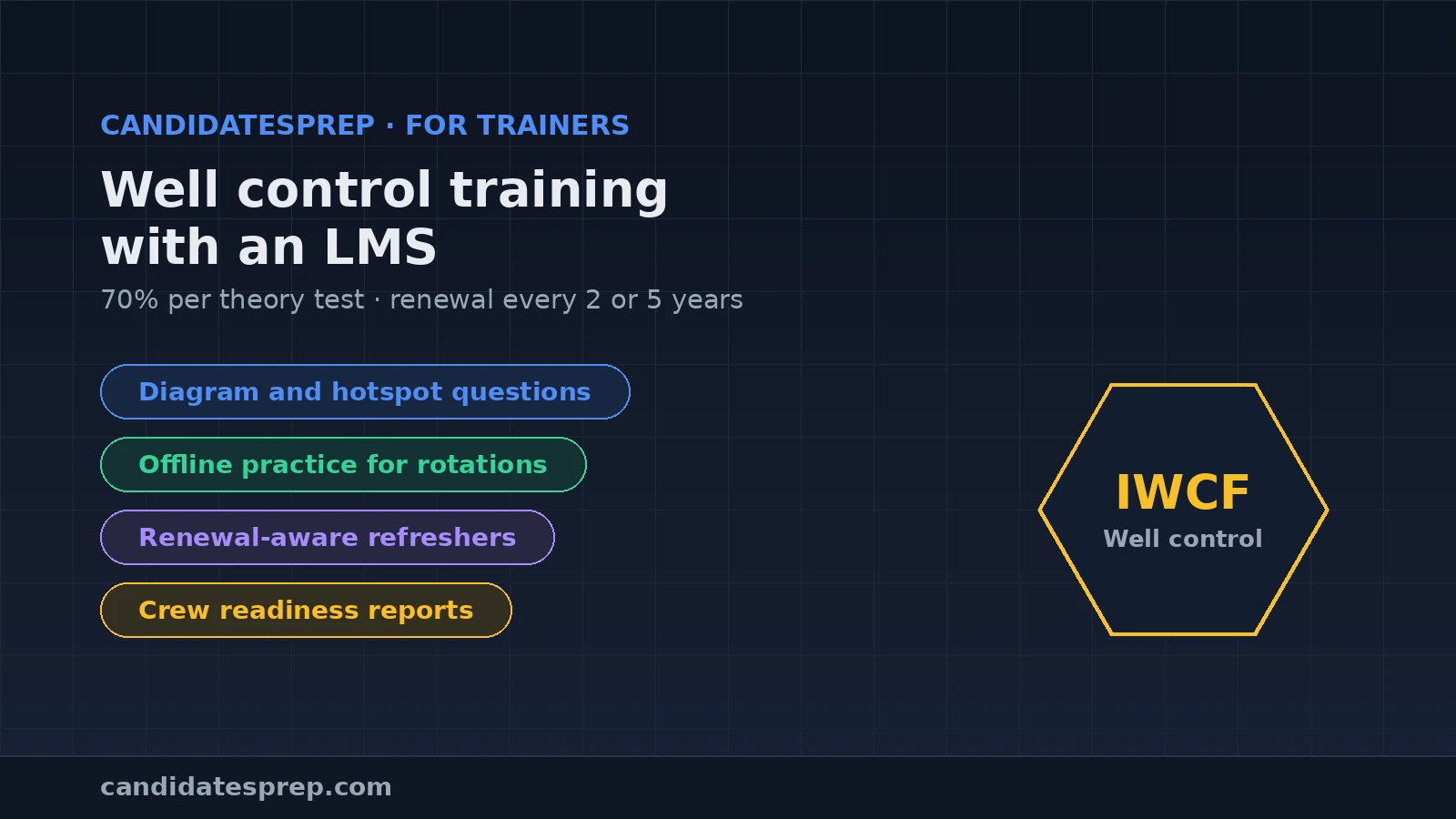
IWCF drilling well control certification combines multiple-choice theory tests, each needing at least 70 percent, with practical simulator assessments at Levels 3 and 4. Certificates must be renewed every two years at Levels 3 and 4, and every five years at Level 2, so preparation is a recurring cycle rather than a one-off. Here is how an LMS helps drilling trainers and operators.
How IWCF drilling assessments work
According to IWCF, candidates complete an accredited course and then sit their assessments. Level 2, for well-site roles whose actions could affect well control, has two theory tests with a minimum of 70 percent in each, and its certificate is valid for five years. Levels 3 and 4, for equipment operators and supervisors, add a practical simulator assessment, and their certificates are valid for two years. Theory tests use multiple-choice problem questions, including identifying equipment components and procedures from diagrams and schematics, and are invigilated at accredited centers. Check IWCF for current requirements.
Why it is demanding
- Safety-critical content: mistakes in well control can have serious consequences, so understanding must be solid.
- Visual questions: candidates must read diagrams and schematics accurately.
- Recurring renewal: crews return for revalidation on a fixed cycle.
- Rotational workforces: personnel work on rotation, often offshore or in remote locations.
How a good LMS helps
- Diagram-based questions: hotspot and image-based items let candidates practice identifying components and procedures from schematics.
- Calculation practice: numeric items support well control calculations alongside multiple-choice questions.
- Realistic pass marks: set practice papers at 70 percent, so candidates know exactly where they stand.
- Offline practice: CandidatesPrep offers an installable app that works offline for practice, which suits personnel on rotation with limited connectivity.
- Renewal-aware refreshers: schedule refresher courses and mocks ahead of renewal dates, and keep transcripts showing continuous learning.
- Company reporting: operators and contractors can export reports showing which crew members are ready.
What an LMS does not replace
Simulator assessments test practical response under pressure, and they take place at accredited centers. An LMS prepares the knowledge and theory side thoroughly, and can structure pre-course and refresher learning, but it complements hands-on simulator training rather than replacing it.
Build a continuous cycle
Instead of cramming before each renewal, keep crews engaged with short, spaced refreshers between certifications. That keeps knowledge current, reduces renewal stress and, most importantly, supports safer operations. Our guide to cramming vs spaced study explains why little and often wins.
The bottom line
IWCF certification is safety-critical, visual and recurring. An LMS with diagram-based questions, offline practice, renewal-aware scheduling and clear reporting helps drilling trainers and operators keep crews competent and certified.
Explore our corporate L&D solutions, try the CandidatesPrep simulator, or book a demo.