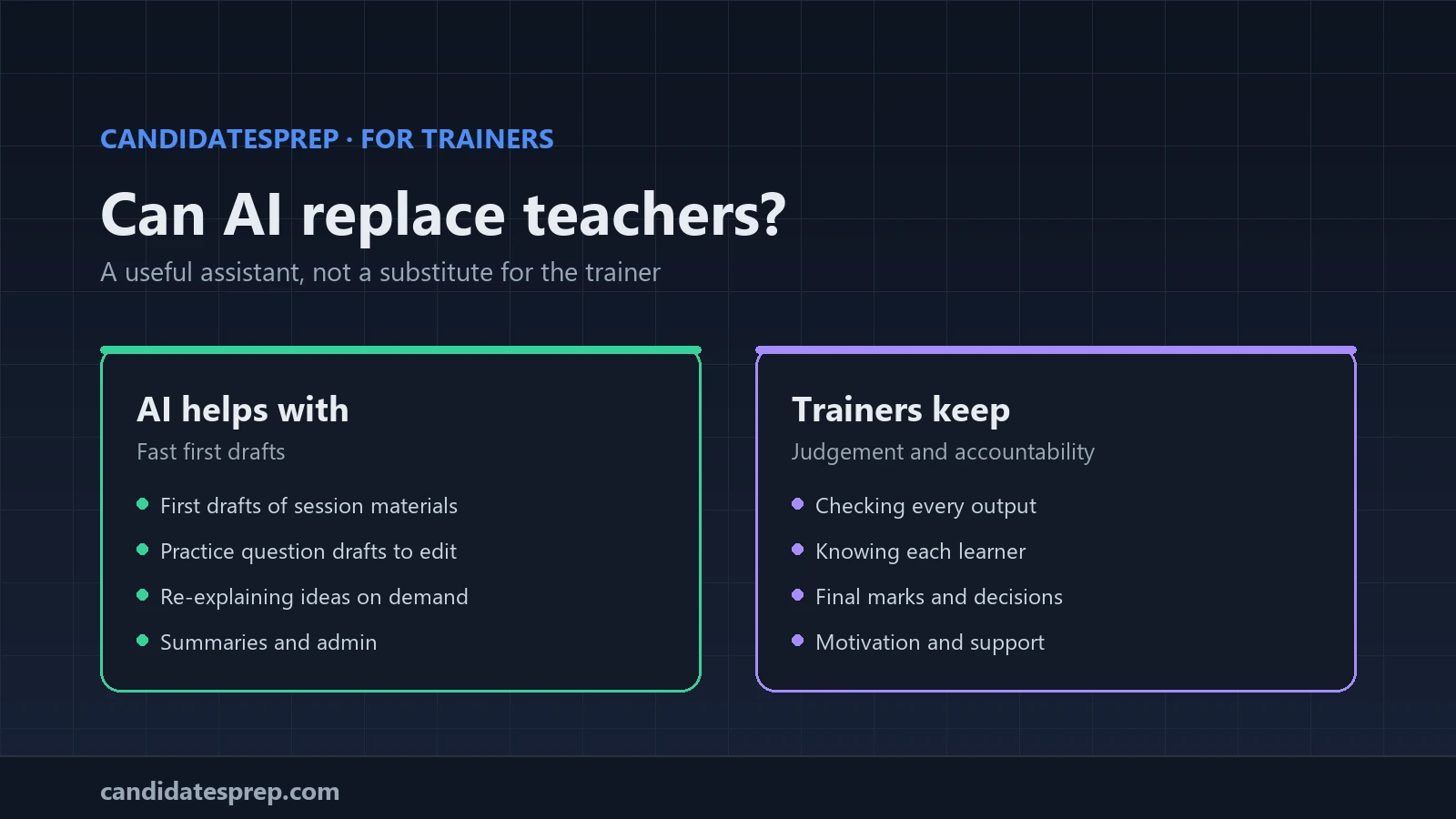
No. AI can draft materials, generate practice questions and give quick feedback, but it cannot replace a trainer's judgement, motivation or accountability. The best results come from trainers who use it deliberately and check everything it produces. Here is where it helps, where it falls short, and how to use it responsibly.
What AI does well
Generative AI is good at producing a reasonable first draft quickly. For trainers, that includes:
- Outlines, worked examples and analogies for a session.
- Explanations of the same idea at different levels, for mixed groups.
- First drafts of practice questions and plausible wrong answers, ready for you to edit. Our guide to writing good multiple-choice questions shows what to check.
- Rewording instructions, summarising long documents and tidying admin.
Guidance for schools in England from the Department for Education (DfE) notes that generative AI "can make certain written tasks quicker and easier". For learners, it can be a patient study partner that re-explains and quizzes on demand; our guide to studying with AI without cheating covers how learners should use it.
What it cannot do
The same guidance is plain about the limits: tools can produce false or inaccurate information presented as fact, outputs can be biased or out of date, and they may not match your curriculum. Beyond accuracy, AI cannot:
- Know your learners: their history, their confidence, or what is going on in their lives.
- Notice that someone has gone quiet, and have the conversation that keeps them on the course.
- Weigh what matters most in a messy, real situation, which is exactly what many professional exams test.
- Take responsibility. The DfE guidance says responsibility for final work stays with the professional who produced it and their organisation, whatever tools were used.
AI in assessment: useful, with limits
Automatic marking of objective questions is long established and does not need generative AI. The harder case is written answers. AI can suggest a mark or point out strengths and gaps, but for anything that counts, a person should make the final decision, because a candidate who queries a mark deserves an explanation from someone accountable for it.
Integrity is the other side. Candidates may use AI to answer questions, and AI text detectors are not reliable enough to prove it, as our post on whether online exams can detect AI explains. Supervised conditions and questions that test applied judgement do more than any detector.
What the policy guidance says
UNESCO's Guidance for generative AI in education and research, published in September 2023, takes a human-centred view: it calls for protecting users' data privacy, validating tools ethically before they are used in teaching, and age limits for independent use. UNESCO's AI competency framework for teachers, published in August 2024, sets out 15 competencies across five dimensions, including a human-centred mindset, the ethics of AI and AI pedagogy.
In England, the DfE's guidance, last updated in August 2025, asks staff to use their professional judgement, check outputs for accuracy and keep personal data out of generative AI tools. Guidance in this area changes often, so check the current versions before setting your own policy.
Using AI responsibly as a trainer
- Check every output before learners see it, especially facts, figures and answer keys.
- Keep learners' personal data out of general-purpose AI tools, and follow your organisation's policy.
- Tell learners how you use AI, and set clear rules for how they may use it.
- Keep a person in charge of high-stakes decisions: final marks, certification and misconduct cases.
- Spend the time AI saves on the human work: feedback conversations, coaching, and catching learners who are slipping.
Where CandidatesPrep fits
On CandidatesPrep, objective questions are marked automatically, and written answers go to a trainer marking queue with assisted suggestions, so marking moves faster while the final mark stays with you. Every result breaks down by topic, and item analysis shows which questions are not performing, a useful check on any question however it was drafted. Questions can go through an approval workflow before use, and exams can run under proctoring with ID checks, screen lock and tab-switch detection. See how training institutes put this together.
The bottom line
AI can take on drafting, practice and some marking support, but it cannot know your learners, take responsibility for their results or keep them going when they struggle. Trainers who use it carefully, check its work and keep the human parts human get the benefit without handing over what matters.
See how marking and topic-level results work on the CandidatesPrep simulator, or book a demo to set up a trainer marking queue for your courses.