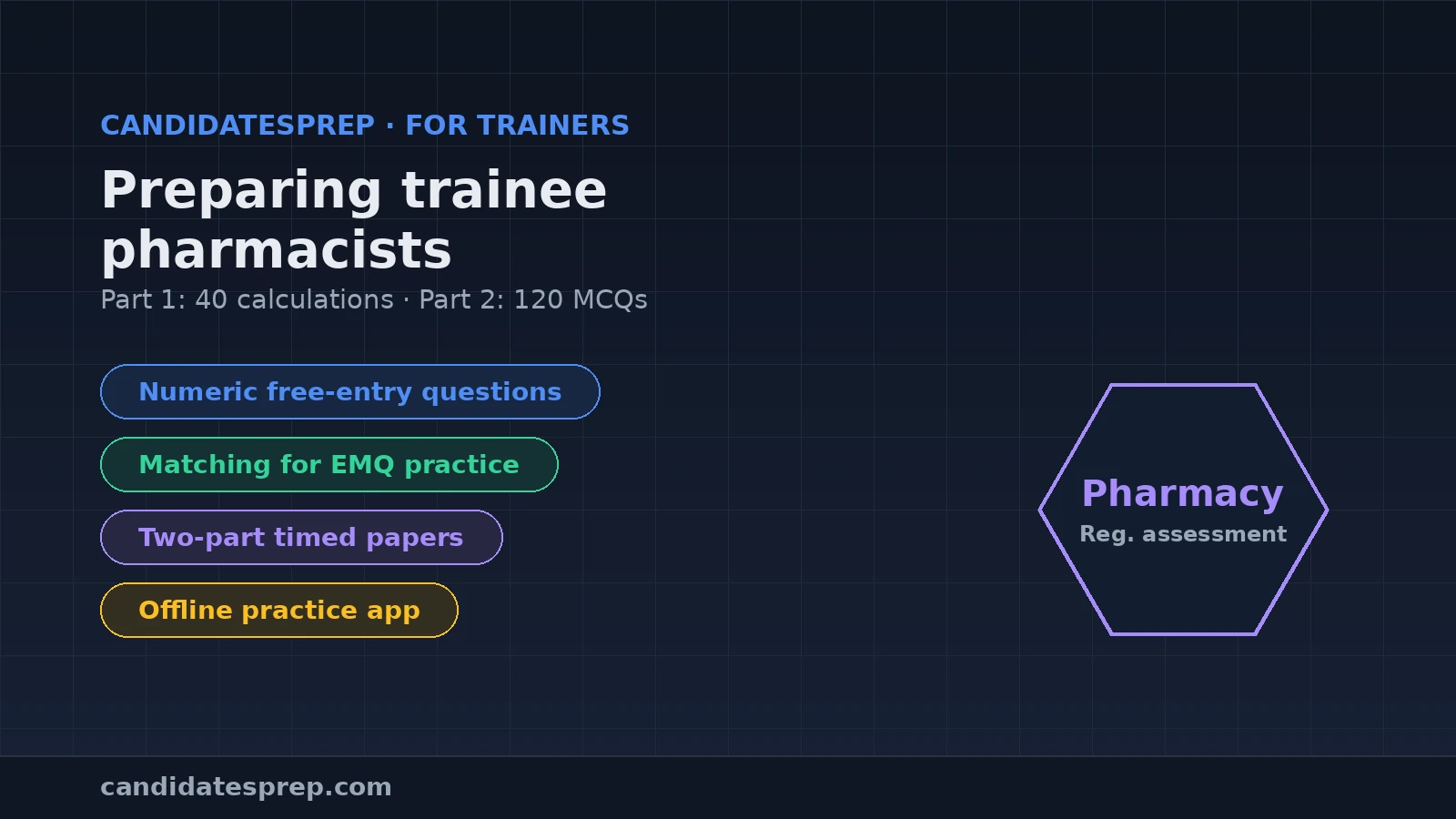
The UK Common Registration Assessment has two computer-based parts: 40 calculations answered by free numerical entry in 120 minutes, and 120 multiple-choice questions in 150 minutes. Trainees must pass both parts at the same sitting. For training providers and employers, an LMS that handles numeric answers, matching questions and timed papers makes preparation far more realistic. Here is how.
What the assessment involves
The Common Registration Assessment is delivered jointly by the General Pharmaceutical Council and the Pharmaceutical Society Northern Ireland, usually with two sittings a year. Part 1 contains 40 pharmacy and healthcare calculations with free-entry numerical answers, with 120 minutes allowed. Part 2 contains 120 questions in 150 minutes: 90 single best answer questions with five options each, and 15 sets of extended matching questions, each set having two questions that share the same eight options. Candidates must reach the pass mark on both parts at the same sitting, and can attempt the assessment up to three times within the time limit for applying to register. Always check the current framework on the GPhC website.
Why it is tricky to prepare for
- Calculations without options: free-entry answers leave no multiple-choice safety net, so accuracy has to be genuine.
- Two formats in one paper: single best answer and extended matching reward different techniques.
- Both parts must be passed together, so strength in one cannot cover weakness in the other.
- Trainees are usually studying alongside a demanding foundation training year.
How a good LMS helps
- Numeric questions: CandidatesPrep supports numeric item types, so trainees practise entering exact answers rather than spotting the right option.
- Matching practice: matching-style questions let trainees rehearse the shared-option logic of extended matching sets.
- Two-part timed papers: build papers with the real durations, so trainees practise pacing for each part separately.
- Topic tagging: tag questions by clinical area and calculation type, and every result breaks down by topic, so tutors can see exactly where a trainee is weak.
- Flexible access: browser-based papers and an installable app with offline practice let trainees study around their shifts.
- Records: transcripts and exportable reports help employers and education supervisors track progress through the training year.
Treat calculations as a daily habit
Calculation accuracy improves with frequent short practice far more than with occasional long sessions. Short, regular numeric quizzes spread through the year, followed by full timed papers closer to the assessment, build both accuracy and stamina. Our guide to spaced repetition explains why spreading practice beats cramming it.
Use mock data to target support
Because both parts must be passed together, it pays to spot lopsided performance early. Watch each trainee's Part 1 and Part 2 mock results separately, and direct extra support to whichever part is lagging, rather than waiting for the real sitting to reveal it.
The bottom line
The Registration Assessment rewards precise calculation and confident clinical reasoning under time pressure. An LMS that supports numeric and matching items, realistic two-part timing and topic-level data lets pharmacy educators prepare trainees systematically.
See our healthcare and compliance solutions, try the CandidatesPrep simulator, or book a demo.