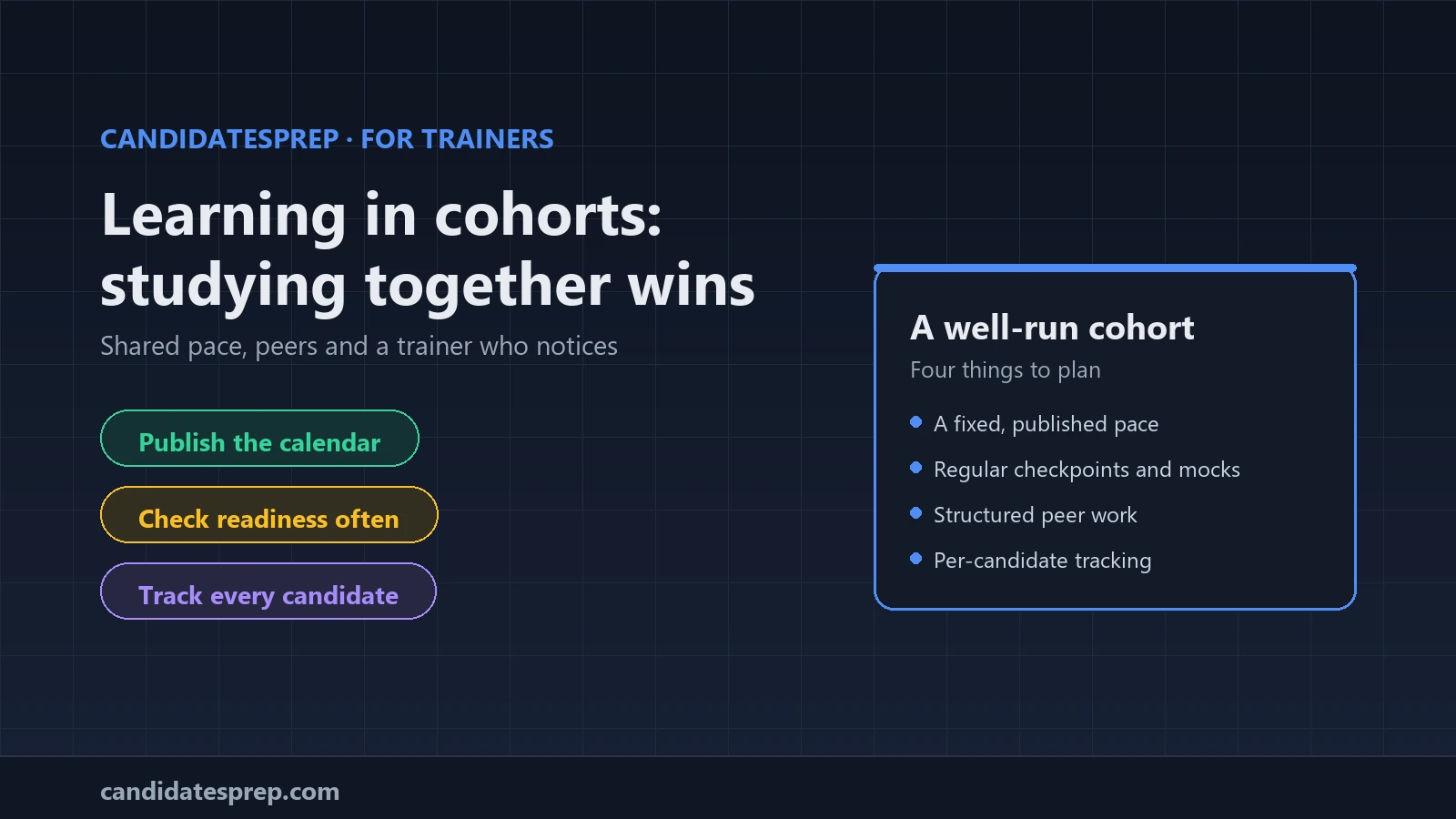
Cohort-based learning works because it adds what self-paced study lacks: a shared start date, regular deadlines, peers to work with and a trainer who notices when someone falls behind. For exam preparation, that structure helps more learners finish the course and arrive at the exam ready. Here is why it works, and how to run a cohort well.
Why self-paced study stalls
Self-paced courses are flexible, but flexibility cuts both ways. With no start date, no deadline and nobody waiting for you, it is easy to drift. Open online courses show the problem at scale: a 2019 analysis published in Science, using data on the courses Harvard and MIT offer through edX, found that low completion rates had not improved over six years. Learners stop for many reasons, but an absence of structure makes stopping easy. A cohort puts that structure back.
What studying together adds
A cohort starts together, moves through the same material on the same timeline, and is assessed at the same checkpoints. That gives you:
- A shared calendar, so progress has a rhythm instead of depending on willpower.
- Peers who notice when someone goes quiet, and who make sessions worth attending.
- Live, active sessions rather than recorded lectures alone.
- A group to compare each learner with, so you can spot who is slipping.
The active part matters. A 2014 meta-analysis of 225 studies of undergraduate science, engineering and mathematics courses, published in PNAS, found that students in classes with traditional lecturing were 1.5 times more likely to fail than students in classes with active learning. The research comes from university courses, but the lesson carries over: learners should spend sessions doing, not just listening.
Set the pace with a fixed calendar
Publish the whole timeline on day one: weekly topics, checkpoint dates, mock dates and the target exam window. Release material in order so nobody races ahead into topics they are not ready for, and keep each week's workload realistic for people studying alongside a job. Leave a buffer week before the exam for revision and catching up, because somebody always needs it. Revisit earlier topics in later weeks too; our guide to spaced repetition explains why spreading practice out helps it stick.
Build in checkpoints
Checkpoints turn a timeline into evidence. Use short topic quizzes most weeks and full timed mocks at a few fixed points, for example a third of the way in, two thirds of the way in, and a week or two before the exam. Agree a readiness bar in advance, such as a target score on two consecutive mocks, before anyone books the real exam. Then act on the results: reteach the topics where the whole group is weak, and give individuals targeted practice where only they are.
Make peer work structured
Peer work helps when it has a clear task, and drifts when it does not. Give pairs or small groups something specific to produce: explain a concept to each other without notes, mark a sample written answer against the mark scheme, or work through a case study and present their reasoning. Rotate groups so learners hear different approaches, and circulate so you can correct misconceptions early. Between sessions, encourage learners to meet on their own; our guide to running a study group covers how.
Track every candidate, not the average
A healthy group average can hide individuals who are struggling. Watch for missed sessions, unfinished modules, mock scores that are flat or falling, and topics where one learner sits well below the rest of the group. Act early with a short conversation and a specific plan, because the further behind someone falls, the harder it is to catch up. If a learner is not ready by the exam window, moving them to the next cohort is often kinder than letting them sit unprepared.
Run your cohort on CandidatesPrep
If you run cohorts on CandidatesPrep, the tools map onto this routine. You can import a roster in bulk, organise learners into programmes and trainer-led classes, and schedule quizzes, mocks and exams for a whole batch at once. Learning paths unlock in order, so the cohort moves through material in sequence. Practice mocks mirror the real exam's timer, navigation and flagging, every result breaks down by topic, and per-candidate readiness shows who is on track. Item analysis shows where the whole group is struggling, so you know what to reteach. See how it works for independent trainers and training institutes.
The bottom line
Cohorts work because they give learners a shared pace, regular checkpoints, peers to learn with and a trainer who can see who needs help. Plan the calendar, structure the peer work and track individuals, and more of your learners will finish the course ready for the exam.
Try a timed mock on the CandidatesPrep simulator, or book a demo to set up your next cohort.