AI tools can make you a faster and deeper learner, but only if you use them to build your own understanding rather than to replace it. Used to shortcut the thinking, they leave you helpless on exam day, when the AI is not there. The line is simple: let AI coach your learning, never do the learning for you. Here is how to stay on the right side of it.
Keep the goal in mind
The point of studying is to get knowledge and skill into your own head, because the exam tests you, not your tools. Any use of AI that builds your understanding is fair game; any use that bypasses it is borrowing competence you will not have on the day. Hold on to that distinction and most specific questions answer themselves.
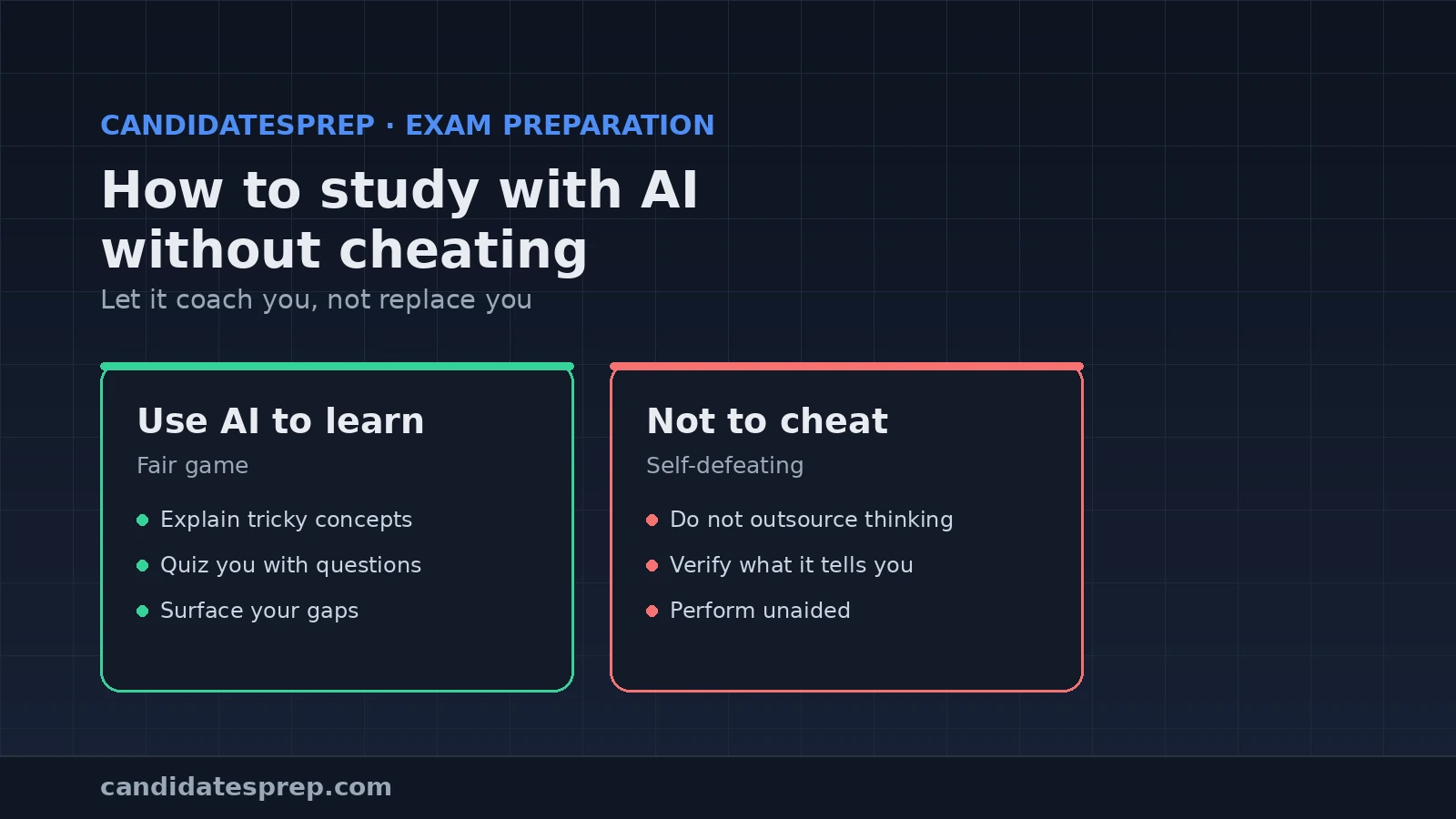
Good ways to study with AI
- Ask it to explain a tricky concept in simpler terms, or in a few different ways until one clicks.
- Have it generate practice questions so you can test yourself through active recall.
- Use it as a patient tutor to probe your understanding and surface gaps.
- Ask it to summarise a topic, then check that summary against a trusted source.
In each case you are still doing the thinking; the AI is a study aid, not a substitute.
Where it tips into cheating
Submitting AI-written work as your own, or leaning on it to answer during an assessment, is cheating, plainly. It also quietly robs you, because the understanding never forms. Beyond honesty, it is self-defeating: you walk into the exam without the skill you were supposed to build. The short-term shortcut is a long-term loss.
Always verify what it tells you
AI tools can state wrong things confidently, so never treat an answer as gospel. Check anything important against your textbook, official exam materials or the issuing body's own guidance. This habit protects you from learning errors and builds the critical judgement that good professionals and good exam candidates share.
Do not let it make you passive
The biggest risk is subtler than cheating: letting AI do the mental work that learning requires. Reading an AI explanation feels productive, but if you never close the tool and retrieve the idea yourself, little sticks. Use AI to prepare the ground, then test yourself without it. Retrieval, not reading, is what builds durable memory.
Know your institution's rules
Schools, universities, professional bodies and employers increasingly have explicit policies on AI use, and online assessments may be monitored. Check the rules for your specific exam, since what counts as acceptable support in one context may be prohibited in another. When in doubt, ask rather than assume, and see our guide to what online proctoring flags.
Practise under real exam conditions
The real test of whether you have learned, rather than leaned on a tool, is performing without one. CandidatesPrep gives you timed mocks with no AI assistance, so you find out honestly whether the understanding is yours. Trainers can use them to confirm genuine readiness across a cohort.
The bottom line
Let AI explain, quiz and stretch you, then do the remembering yourself and verify what it says. Use it to learn, never to avoid learning, and you get a powerful tutor without surrendering the skill the exam is there to test.
Check that the learning is really yours: sit a timed, unaided mock on the CandidatesPrep simulator, or book a demo to confirm a cohort's readiness.