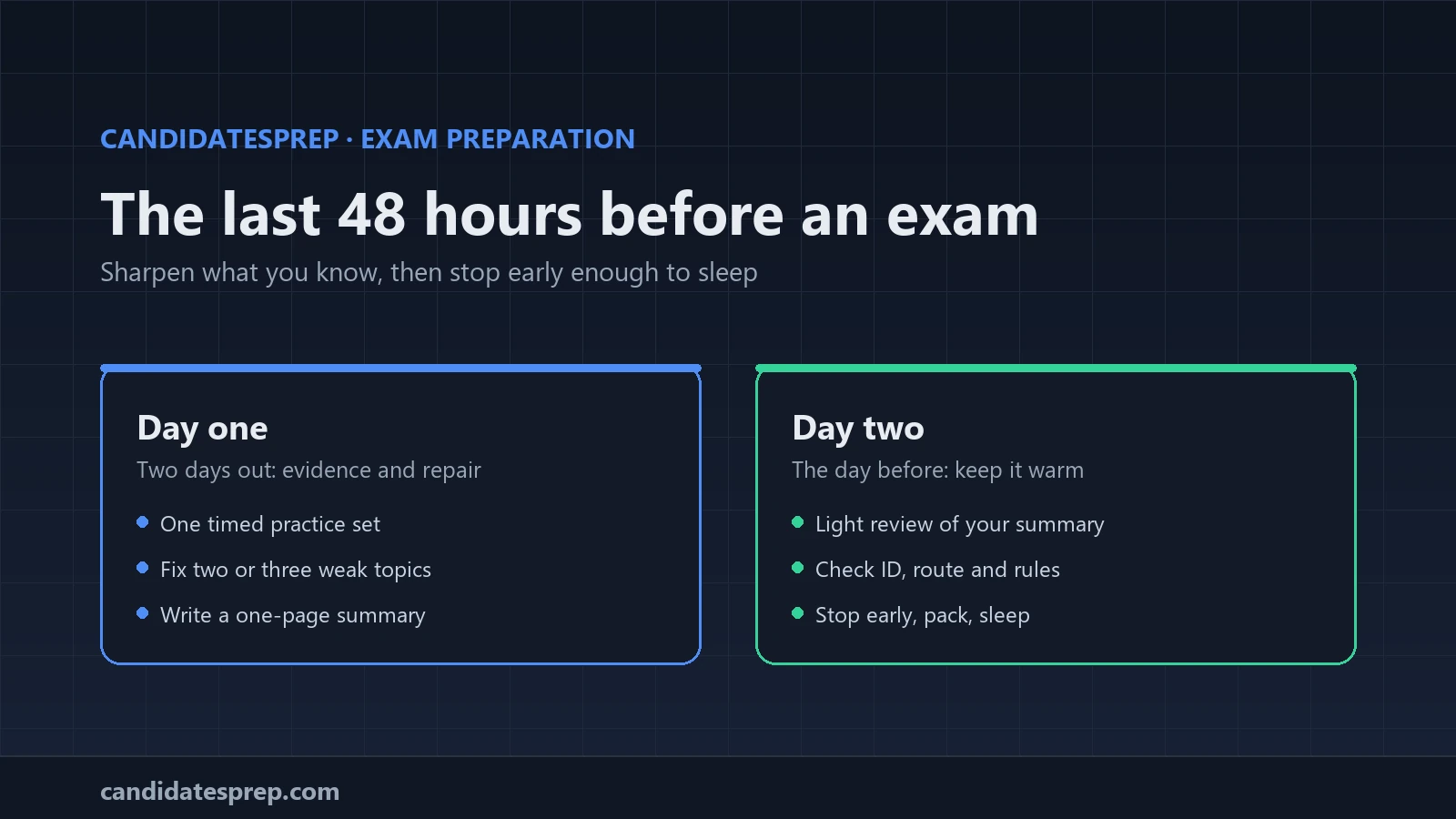
Use the last 48 hours to sharpen what you know, not to learn new material. Spend the first day testing your weakest topics and building a one-page summary; spend the second reviewing lightly, settling every practical detail and stopping early enough to sleep. Here is what to do on each day, and what to drop.
What two days can and cannot do
Forty-eight hours is not enough to learn a large topic from scratch, and trying usually costs sleep and confidence for little gain. It is enough to sharpen recall of what you have already studied, close a few small gaps and remove the practical problems that derail people on the day. If you are still meeting big parts of the syllabus for the first time, our guide to cramming vs spaced study explains how to split even a short run-up into several sessions with sleep in between. This post assumes the groundwork is done.
Day one: test, fix and summarise
Two days out is your last real working day, so use it for evidence and targeted repair.
- Morning: sit one timed practice set while you are fresh. A mixed set or a shorter mock is enough; the aim is a final read on your weak spots, not a verdict.
- Late morning: go through every wrong answer and every lucky guess, and note the topic each belongs to.
- Afternoon: pick the two or three topics that cost you the most marks and can be fixed quickly, such as definitions, formulas, process steps or commonly confused terms. Work on them in short rounds, questions first and notes only to check. Our guide to active recall shows the method.
- Evening: write a one-page summary sheet from memory, then check it against your notes. Include formulas, key definitions, the traps you keep falling into and your pacing plan. Then stop at your usual time.
Day two: review lightly and stop early
The day before the exam is for keeping material warm, not heavy lifting.
- Run through your summary sheet two or three times in short sessions, covering each line and recalling it before you look.
- Answer a few practice questions from topics you know well, so you finish on a run of correct answers rather than a fresh list of gaps.
- Rehearse your pacing plan: roughly how long each question should take, when you will check the clock, and what you will do with a question you cannot answer (flag it, move on, come back).
- Choose a finish time in the early evening and keep to it. Pack your bag, then do something calming.
For the evening and the morning itself, our guide to exam-day nerves covers sleep, breakfast and a routine for the first few minutes.
What to drop
Some habits feel productive this late and mostly add stress.
- New resources. A new book, video course or question bank mostly shows you what you do not know.
- Topics you have never studied. Accept the gap and protect what you do know.
- Full-length mocks the day before. They tire you, and a poor score leaves no time to act on it.
- Rewriting or decorating notes. It looks like work but involves little recall.
- Late nights. Trading sleep for one more session rarely pays off on the day.
- Anxious group chats. Other people's panic about what they have not covered is catching.
Settle the logistics early
Practical problems are the easiest to prevent, so deal with them on day one or early on day two.
- Confirm the date, start time and time zone on your booking.
- Plan the route to the venue with a generous buffer, and check for travel disruption.
- Check which ID your exam provider accepts, that it is in date and that the name matches your booking.
- Check what you may bring, such as a permitted calculator, glasses or water.
- For an online proctored exam, follow your provider's rules to the letter. Pearson VUE's online testing guide, for example, recommends running its system test again two to three days before the exam on the computer and connection you will use, and lets you check in from 30 minutes before your appointment. Rules vary by exam, so check your own exam's page for current details.
Practise under real exam conditions
Day one works best when your practice set behaves like the real thing. On CandidatesPrep you can sit a timed mock that mirrors the real exam's timer, navigation and flagging, then use results broken down by topic to choose the two or three areas worth fixing. Trainers can schedule a final mock for a whole cohort at the right point in the run-up, so everyone gets the same last read on their weak spots.
The bottom line
The last 48 hours reward restraint: one day of testing and targeted repair, one day of light review and practical checks, then sleep. Drop anything new, settle the logistics early and walk in with what you already know sharp.
Get your final read on weak topics with a timed mock on the CandidatesPrep simulator, or book a demo to schedule final mocks for a whole cohort.