No skill is completely recession-proof, but some hold their value far better than others when the economy tightens, usually because they meet needs that do not disappear or solve problems employers still pay for in hard times. Building a few of these, and being able to prove them, is one of the best forms of career insurance. Here is where to look.
What makes a skill resilient
Skills stay in demand through a downturn when they meet persistent needs, keep organisations running or save them money, and are hard to replace. Work tied to essential services, to security and compliance, or to efficiency tends to hold up better than work that is easy to cut when budgets shrink. Think in terms of problems that do not go away.
Durable skill areas to consider
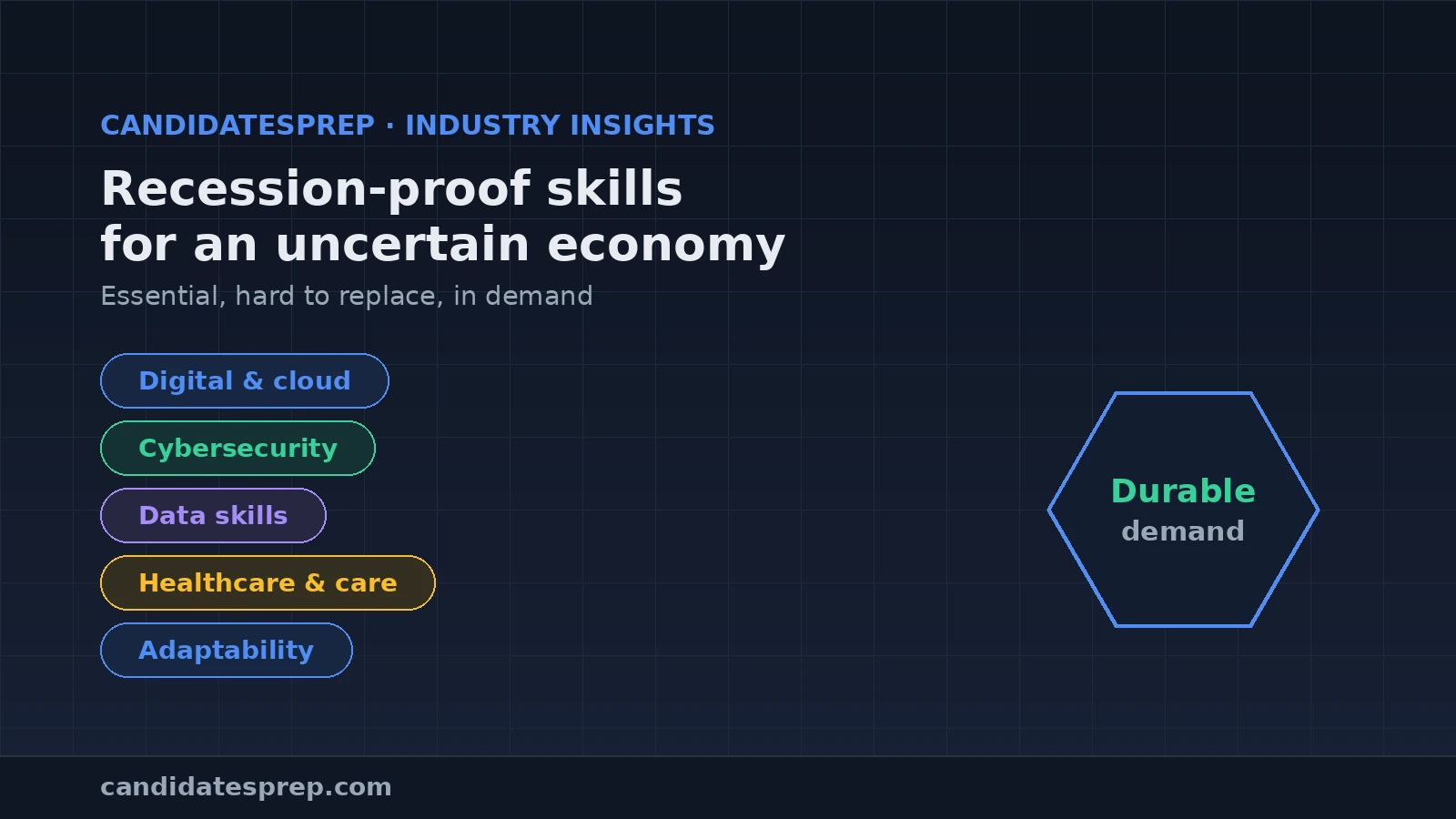
- Digital and cloud skills, which keep modern organisations functioning.
- Cybersecurity, where threats persist regardless of the economy.
- Data skills, since decisions still need to be informed when money is tight.
- Healthcare and care work, driven by needs that do not pause for a recession.
- Skilled trades, which stay in demand and resist offshoring and automation.
- Adaptability itself, the meta-skill of learning new things quickly.
This is not an exhaustive list, and the right choice depends on your situation, but the pattern is clear: essential, hard-to-replace, problem-solving work.
Depth and proof both matter
In a tight market, employers can be choosier, so demonstrable competence beats a vague claim. This is where credentials earn their keep: a recognised certification is evidence you can do the work, which matters more when there are more applicants per role. Our honest look at whether certifications are worth it can help you choose ones with real payoff.
Adaptability is the real insurance
Specific skills rise and fall, but the ability to learn new ones quickly never goes out of demand. The most resilient professionals are not those who know one thing deeply and nothing else, but those who keep learning and can move towards where the work is. Treat reskilling as a continuous habit, not a one-off panic when trouble hits.
Combine hard and human skills
Technical skills get you considered; the human skills of communication, teamwork and judgement often decide who stays when teams shrink. People who are both capable and easy to work with tend to be the last to be let go. Our piece on why soft skills are the new hard skills explains why that pairing is so powerful.
A practical plan
Audit where your current skills sit against the resilient pattern, pick one durable area to deepen or add, back it with a recognised certification, and keep a habit of learning. You cannot control the economy, but you can make yourself the kind of professional organisations work hard to keep.
Practise under real exam conditions
If you decide to certify in a resilient field, the exam still rewards preparation. CandidatesPrep gives you timed, domain-scored mocks so you certify with confidence rather than hope. Trainers can reskill a whole team towards more durable, in-demand capabilities.
The bottom line
Nothing is truly recession-proof, but essential, hard-to-replace, problem-solving skills, backed by proof and paired with adaptability, keep you employable when the economy turns. Build them before you need them.
Future-proof your skills with a recognised credential: sit a timed mock on the CandidatesPrep simulator, or book a demo to reskill a team.