Useful feedback describes a specific piece of work or behaviour, explains its effect, and points to what to do next; it is about what someone did, not who they are. Receiving it well means listening fully, asking questions, and then deciding what to act on. Here is how to do both, at work and when marking practice answers.
Why feedback goes wrong
Most feedback fails for predictable reasons. It is too vague ("good job", "needs work"), it arrives weeks after the moment, it judges the person instead of the work, or it lists so many points that none of them sticks. Each of these leaves the other person unsure what to change. The fixes are simple, even if they take practice.
Giving feedback: use a clear structure
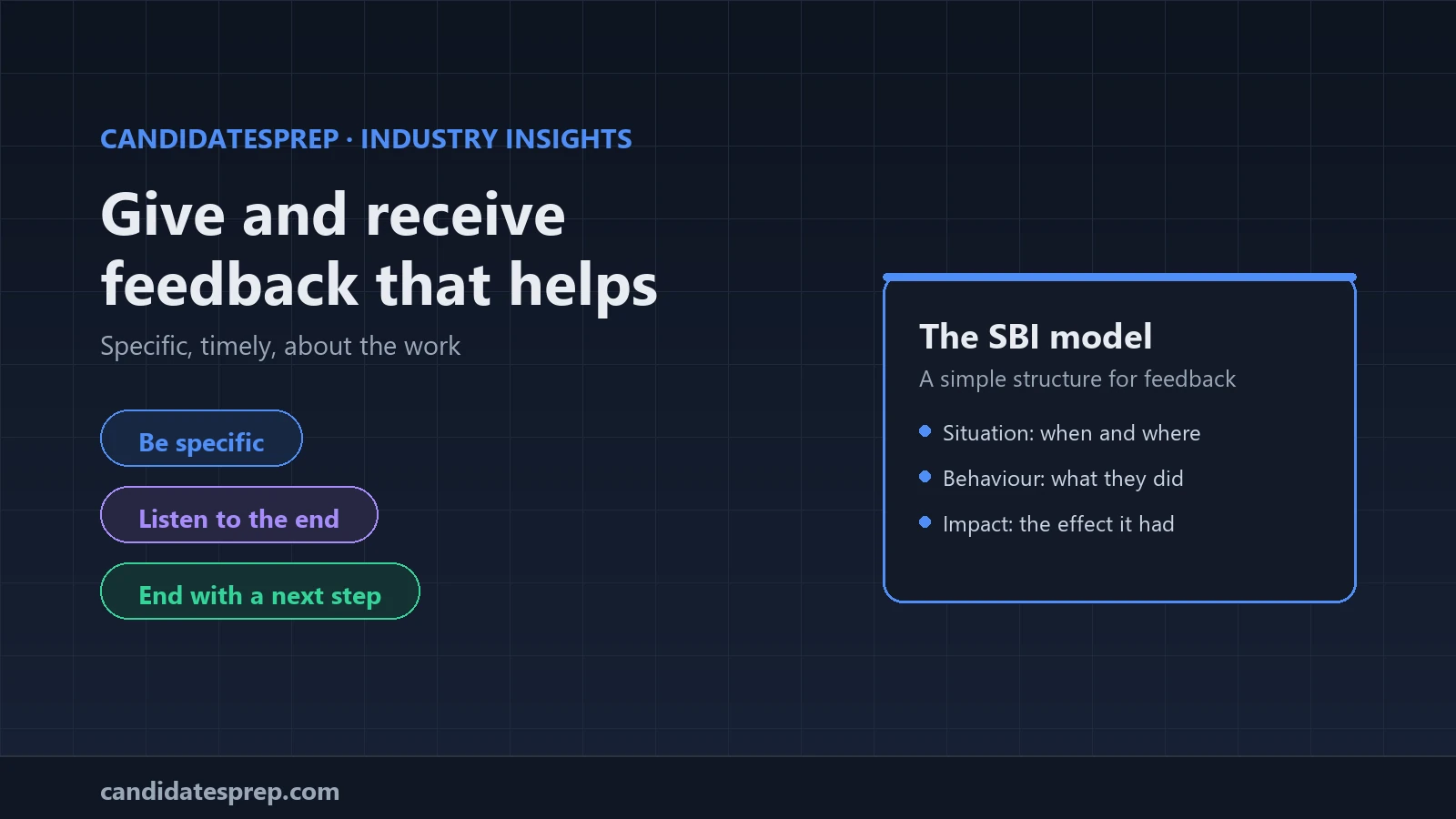
A widely used structure is Situation, Behaviour, Impact, or SBI, developed by the Center for Creative Leadership:
- Situation: say when and where. "In Tuesday's client call..."
- Behaviour: describe what the person did, as something you could observe. "...you walked through the risks before the costs..."
- Impact: explain the effect it had. "...and the client agreed to the revised timeline on the spot."
The same structure works for criticism. "In this morning's handover, you skipped the open incidents, and the next shift spent an hour finding them" is far easier to act on than "your handovers are sloppy".
Giving feedback: timing and tone
- Give it soon, while the moment is fresh for both of you.
- Pick the one or two points that matter most rather than everything you noticed.
- Praise with the same detail as criticism, so people know what to repeat.
- Make it a conversation: ask how they saw it, because there may be context you missed.
- Keep criticism private where you can.
Receiving feedback without getting defensive
Hearing criticism is uncomfortable, and the instinct is to explain or push back. Try this instead:
- Listen to the end before responding.
- Ask for an example if the point is vague: "Can you show me where that happened?"
- Separate the work from your worth. Feedback on one report is not a verdict on you.
- Thank the person, even if you disagree, and take time to think before deciding what to act on.
- Follow up later to show what you changed. It encourages honest feedback next time.
You do not have to accept every point. You do have to hear it properly before you decide.
Feedback on practice answers
For trainers, marking practice work is where feedback does most of its teaching. A few habits make it far more useful:
- Mark against clear criteria, and share those criteria before learners attempt the task.
- Point to the exact part of an answer that earned or lost marks, rather than giving a score alone.
- Share a model answer afterwards, so learners can compare their approach with a strong one.
- End with one specific thing to do differently in the next attempt.
This matters most in scenario-based and written exams, where learners need to see how a good answer applies principles to the situation in front of them. Our guide to NEBOSH training shows this in a health and safety setting.
Make feedback a habit, not an event
Feedback works best as a regular, low-stakes routine rather than a once-a-year review. Short, frequent check-ins keep small issues small and make honest conversation normal. In teams and classrooms alike, people who hear regular, specific feedback are far less likely to be surprised by a poor result.
Put feedback into practice
On CandidatesPrep, every result breaks down by topic, so learners and trainers can see exactly where marks are being lost. Written answers go to a trainer marking queue with assisted suggestions, which makes it quicker to leave specific comments on long-form work. Item analysis and pass rates also show trainers where a whole group is struggling, which is feedback on the teaching as much as on the learners. Learning and development teams can see how this works when training and assessing staff.
The bottom line
Good feedback is specific, timely and about the work, not the person. Receiving it well means listening, asking, and then choosing what to act on. Build both habits and feedback stops feeling like criticism and starts working as guidance.
See topic-level results for yourself on the CandidatesPrep simulator, or book a demo to set up marking and feedback for your cohort.