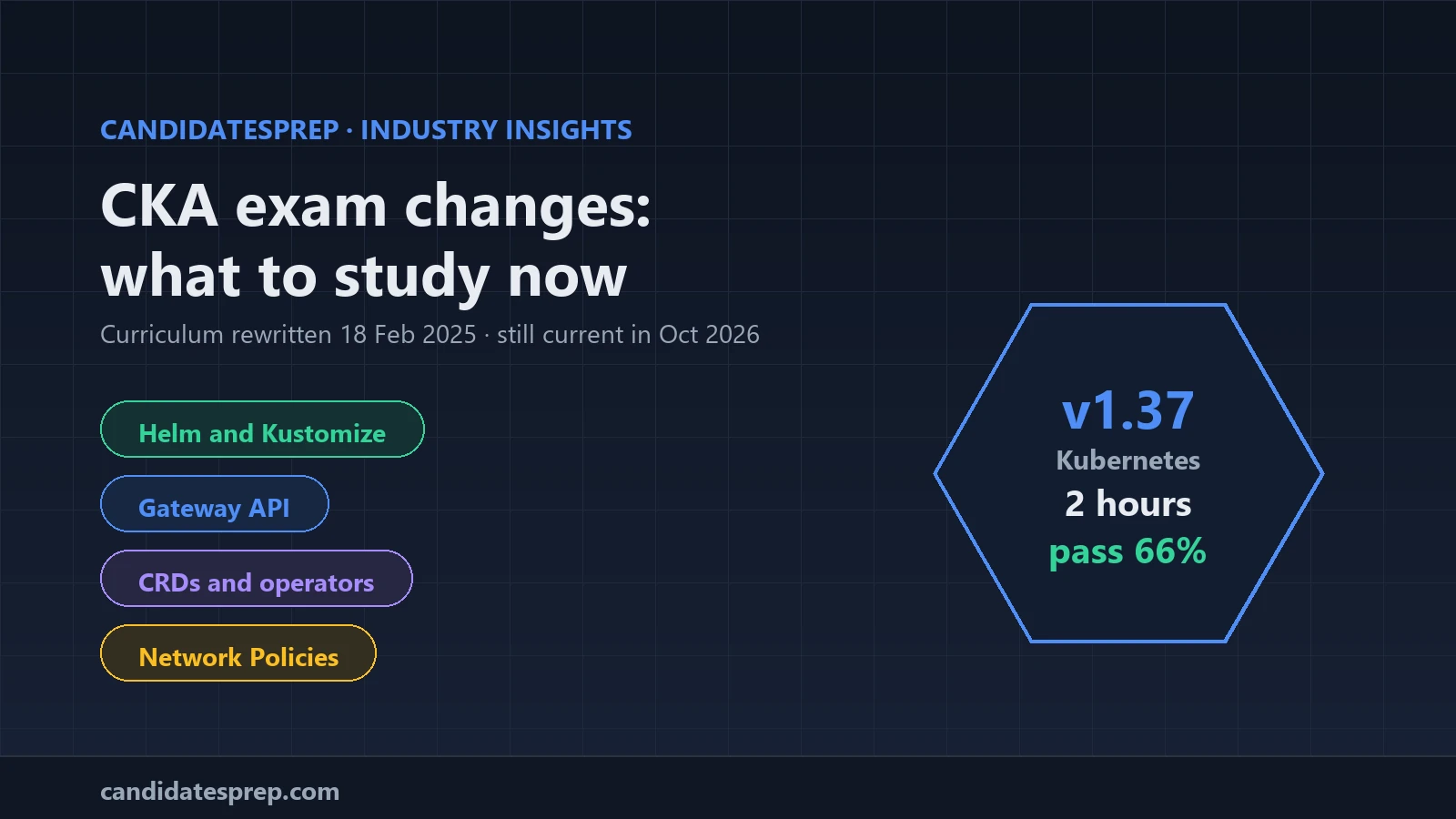
The CKA's five domains and their weightings have not changed, but the skills inside them were rewritten on 18 February 2025, adding Helm and Kustomize, the Gateway API, Network Policies, operators and dynamic storage provisioning. That curriculum is still current in October 2026, and the exam now runs on Kubernetes v1.37. Here is what to study.
The CKA in October 2026
The Certified Kubernetes Administrator exam from the Linux Foundation and CNCF works like this:
- Online, remotely proctored and performance-based: you solve 15 to 20 tasks from a command line, with no multiple choice.
- 2 hours.
- A passing score of 66%.
- Kubernetes v1.37. The environment moves to each new minor release within about four to eight weeks of it shipping.
- Your purchase gives you 12 months to sit the exam and includes one retake if the first attempt is graded as a fail, with no enforced wait.
- The certification lasts two years (three for passes before 1 April 2024). You renew by passing the exam again before it expires.
What changed in 2025, and what did not
The domains and weightings stayed exactly as they were:
- Troubleshooting: 30%
- Cluster Architecture, Installation and Configuration: 25%
- Services and Networking: 20%
- Workloads and Scheduling: 15%
- Storage: 10%
What changed on 18 February 2025 was the list of competencies under each domain. Since then only the Kubernetes version has moved. The v1.37 curriculum in CNCF's repository lists the same competencies as the 2025 rewrite, so material written for the February 2025 version is still on target, while older material is not.
New skills to add to your plan
Comparing the current curriculum with the last version before the change (v1.31), these skills are new or noticeably deeper:
- Use Helm and Kustomize to install cluster components; previously you only needed awareness of templating tools.
- Use the Gateway API to manage ingress traffic, alongside Ingress controllers and resources.
- Define and enforce Network Policies.
- Understand CRDs, and install and configure operators.
- Understand extension interfaces such as CNI, CSI and CRI, rather than just choosing a network plugin.
- Implement storage classes and dynamic volume provisioning.
- Configure workload autoscaling, and Pod admission and scheduling, including limits and node affinity.
- Implement and configure a highly available control plane.
- Monitor cluster and application resource usage as part of troubleshooting.
What was reworded
Some older lines no longer appear word for word. "Implement etcd backup and restore" and the kubeadm version upgrade line were replaced by broader competencies: create and manage clusters using kubeadm, and manage the lifecycle of Kubernetes clusters. Upgrades and etcd backups are everyday lifecycle tasks, so keep practising them. The separate line on host networking configuration was dropped, and the logging lines became "manage and evaluate container output streams".
What to study now
Weight your time by the domains and start where the marks are:
- Troubleshooting: broken nodes, failing control plane components, Services that do not route and Pods that will not schedule.
- Cluster lifecycle: build a cluster with kubeadm, upgrade it, back up and restore etcd, then install components with Helm charts, Kustomize and an operator.
- Networking: Services, CoreDNS, Network Policies, Ingress and the Gateway API.
- Workloads and storage: rollouts and rollbacks, ConfigMaps and Secrets, autoscaling, storage classes and persistent volume claims.
During the exam you may use kubernetes.io/docs, the Kubernetes blog and the Helm docs, and, on the CKA only, the Gateway API docs. Practise finding answers in those pages quickly. Your purchase also includes two sessions on the Killer.sh simulator. For a weekly structure, see our guide to a study timetable that works.
Check the official CKA page and the CNCF curriculum repository before you book, as the Kubernetes version moves several times a year.
Where it fits with CKAD and CKS
The CKA is still the administrator exam and the prerequisite for the CKS. One newer change matters if you plan both: since 18 June 2026, passing or recertifying the CKS automatically extends your CKA to the same expiry date, even if the CKA has lapsed. Our comparison of CKA vs CKAD vs CKS covers which exam suits which role.
Practise under real exam conditions
The CKA is hands-on, so most of your practice belongs in a real cluster. Concept gaps still cost time, though, especially on the newer topics. Short timed quizzes on CandidatesPrep, with results broken down by topic, show whether the Gateway API, operators or storage are your weak spots before you spend lab hours on them. Trainers running Kubernetes cohorts can schedule mocks and track readiness across a group; see how IT and cloud training providers use it.
The bottom line
The CKA has the same shape as before 2025, but the skills inside it are broader: Helm, Kustomize, the Gateway API, operators and dynamic storage are all fair game. Study from material written for the February 2025 curriculum, practise on a recent Kubernetes version, and spend most of your time troubleshooting.
Test your concept knowledge with a timed quiz on the CandidatesPrep simulator, or book a demo to run Kubernetes practice for a whole cohort.