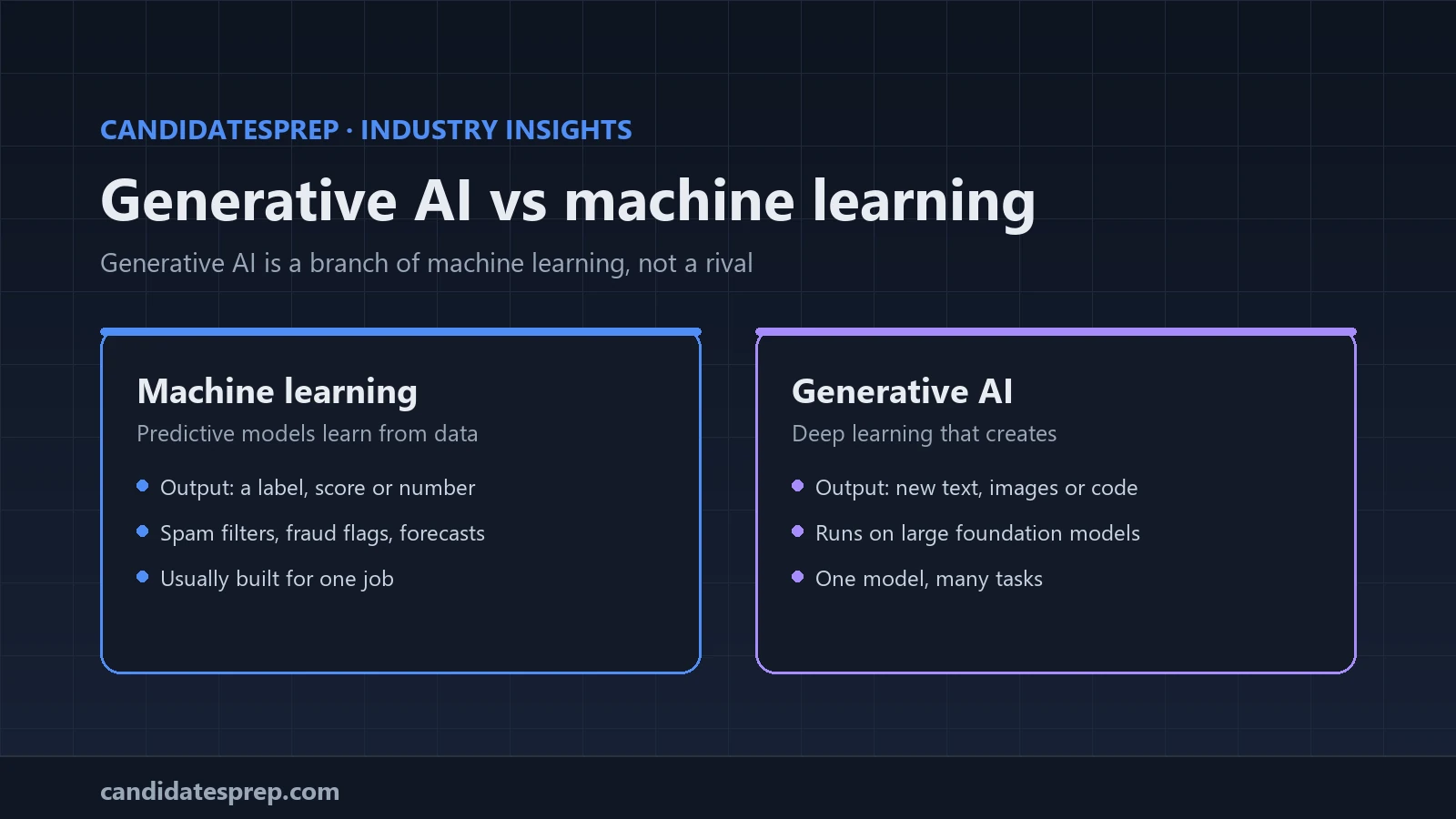
Generative AI is not an alternative to machine learning; it is a branch of it. Machine learning covers systems that learn patterns from data to make predictions or decisions. Generative AI uses very large machine learning models, usually deep learning, to create new content such as text, images or code. Here is how the pieces fit.
How AI, machine learning and deep learning fit together
Think of four nested layers, from broadest to narrowest.
- Artificial intelligence is the umbrella: any technique that lets machines perform tasks we associate with human intelligence. AWS's AI vs machine learning explainer notes that all machine learning is AI, but not all AI is machine learning.
- Machine learning is AI that learns from data rather than following rules a person wrote by hand.
- Deep learning is a subset of machine learning that uses neural networks with many layers, as AWS's deep learning comparison explains. It handles unstructured data such as images, audio and free text well, but demands more storage and computing power.
- Generative AI, as most people use the term today, is the part of deep learning that produces new content. AWS's generative AI overview describes it as a type of AI that can create new content and ideas.
What machine learning does
Most machine learning in everyday business is predictive. A model learns from past examples, then gives an answer for a new case: a category, a score or a number. Typical uses include filtering spam, flagging suspicious transactions, forecasting demand, recommending products and predicting which customers might leave.
The main approaches are supervised learning (learning from labelled examples), unsupervised learning (finding groups or patterns in unlabelled data) and reinforcement learning (learning by trial, error and reward). A model like this is usually built for one job, and its accuracy can be measured against known right answers.
What generative AI does
Generative AI produces something new rather than a label or a score: a draft email, a summary, a translation, an image or a piece of code. It runs on foundation models, large models trained on broad, mostly unlabelled data that can be adapted to many tasks. Large language models are one kind of foundation model, focused on text.
The practical shift is flexibility. One generative model can summarise a report, draft a reply and explain a spreadsheet formula, guided only by your instructions; a predictive model would need separate training for each.
What each is good at
- Predictive machine learning suits narrow, repeatable decisions on structured data, where you can measure accuracy and may need to explain how a result was reached.
- Generative AI suits open-ended language and content work: first drafts, summaries, questions about documents and coding help.
Each has limits. AWS notes that generative AI can produce inaccurate or misleading information and can reflect biases in its training data, and its answers can vary from one run to the next. Predictive models need good, relevant data and only do the task they were trained for. The official AWS Certified AI Practitioner exam guide makes the choice explicit: candidates must identify when traditional machine learning models or foundation models are appropriate, with regulatory concerns and explainability requirements among the factors.
Where the terms get confused
- "AI" used to mean chatbots. AI is far broader: a spam filter or a route planner is AI too.
- Generative AI and machine learning treated as rivals. Generative AI is machine learning, applied to creating content.
- Every chatbot is generative AI. Many older chatbots follow fixed scripts and generate nothing.
- Large language models and generative AI used as synonyms. Language models are one type; image, audio and video generators are others.
- Training and using a model treated as the same thing. Training is when a model learns from data; inference is when it answers your request.
- Agentic AI seen as a replacement. It usually means systems that use a generative model to plan steps and act through tools, so it builds on generative AI.
Getting these right helps when you assess a vendor's "AI-powered" claim. Ask whether the tool predicts or generates, what data shaped it, and who checks its output. Our guide to AI skills worth learning in 2026 covers the practical skills that go with this vocabulary.
Practise under real exam conditions
Foundational AI certifications test exactly these distinctions. The AWS Certified AI Practitioner exam guide asks candidates to "describe the similarities and differences between AI, ML, GenAI, deep learning, and agentic AI"; check the official page for current details before you book, and see our guide to passing the AWS AI Practitioner exam for the format. Definitions feel clear on the page and blur under time pressure, so test them. Timed mocks on CandidatesPrep mirror the real exam's timer, navigation and flagging, and every result breaks down by topic, so you can see which areas need more work.
The bottom line
Machine learning is the discipline of learning from data, deep learning is its most powerful subset, and generative AI is the part that creates new content. Use predictive models for narrow, measurable decisions, use generative AI for language and content, and check the output of both.
Check your understanding with a timed mock on the CandidatesPrep simulator, or book a demo to run AI fundamentals training for your team.