AI literacy is the practical ability to understand what AI tools do, use them well, judge their output and recognise their risks. It is now a baseline workplace skill, not a specialist one. You do not need to code; you need enough understanding to decide when AI helps, when it does not, and what to check before you rely on it.
What AI literacy means in practice
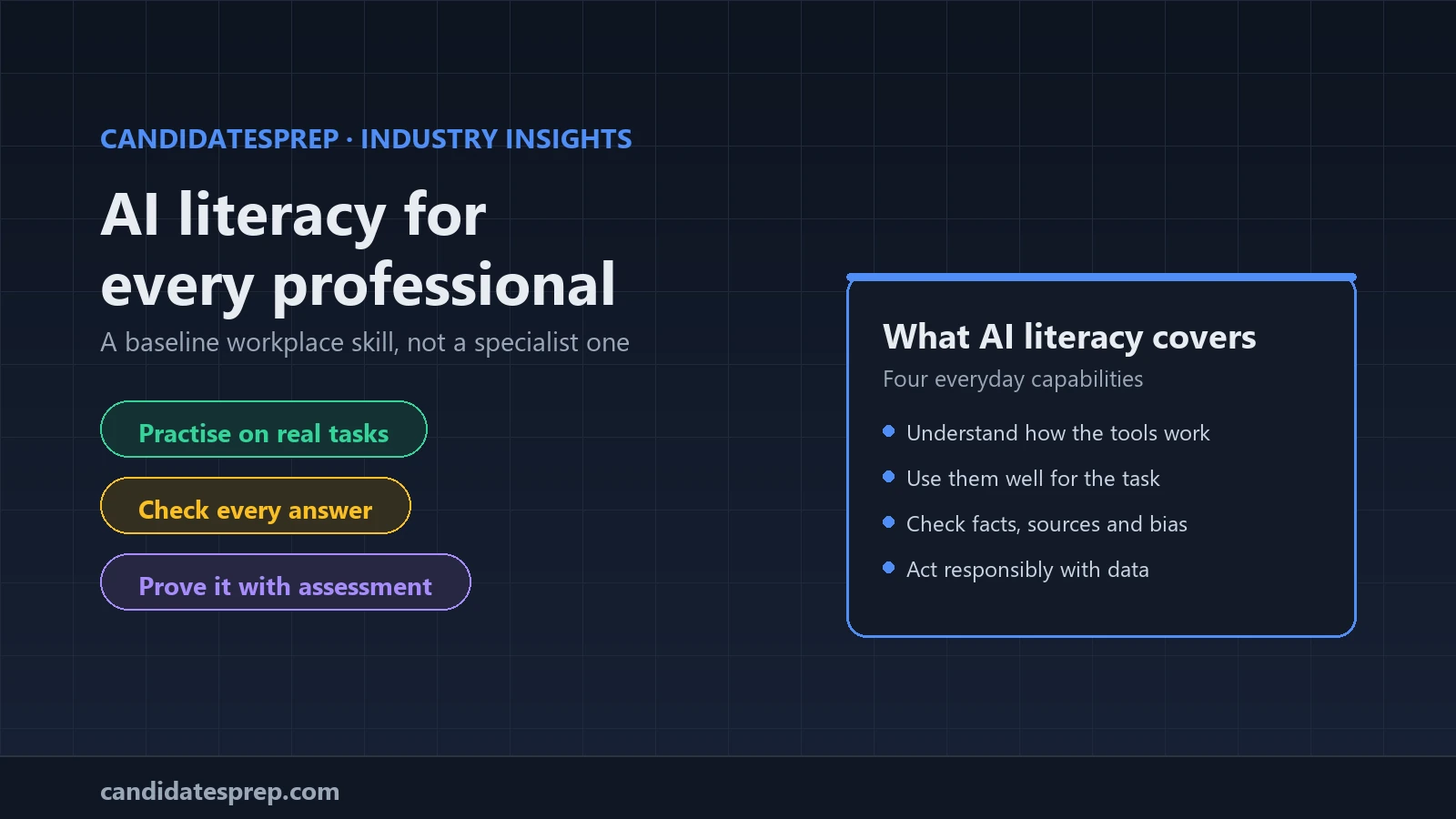
The EU AI Act defines AI literacy as the skills, knowledge and understanding that let people use AI systems in an informed way and be aware of AI's opportunities, its risks and the harm it can cause. At work, that breaks down into four capabilities:
- Understand: know roughly how the tools you use work. A generative AI assistant produces plausible text from patterns in its training data, which is why it can be fluent and wrong at the same time.
- Use: choose the right tool for a task and brief it clearly, with context, constraints and an example of what good looks like.
- Check: verify facts, figures and sources, and watch for bias or gaps in what comes back.
- Act responsibly: know what data you may share, which tools your organisation has approved, and when a person must make the final decision.
Why it matters now
AI is moving into everyday software, from email and documents to search and spreadsheets, so most professionals will use it whether or not they choose a dedicated tool. As our guide to whether AI will take your job explains, AI tends to change tasks rather than remove whole roles, and the people who use it well are best placed. It matters on the other side of the desk too: employers increasingly use AI to screen applications, as our guide to AI in hiring shows, and understanding how it works helps you prepare.
What the EU AI Act requires
Article 4 of the AI Act requires providers and deployers of AI systems to "take measures to support the development of AI literacy" of their staff and others using AI on their behalf, taking account of their knowledge, experience, education, training and the context of use. The AI Act Service Desk shows the current text, which was amended by the Digital Omnibus on AI in July 2026. The amended wording states that the obligation does not require any specific level of AI literacy for any individual.
The European Commission's AI literacy questions and answers add useful detail:
- Article 4 has applied since 2 February 2025, and national market surveillance authorities supervise and enforce it from 2 August 2026.
- No certificate is needed; organisations can keep an internal record of training and other guidance.
- Staff who use generative AI for everyday tasks such as writing or translating should be told about specific risks, for example hallucination.
This is a summary, not legal advice. Check the Commission's pages for current details, and ask your legal or compliance team how the rules apply to your organisation.
How to build your own AI literacy
You can build a solid foundation in a few weeks of steady practice:
- Learn the core vocabulary: AI, machine learning, generative AI, large language model, hallucination and bias.
- Use AI on real, low-risk tasks: draft, summarise or brainstorm, then compare the result with what you would have written.
- Practise checking: test claims against the original source, and open any reference before you trust it.
- Read your organisation's AI policy: which tools are approved, and what data must never go into them.
- Add structure: a short course, or a foundational certification such as AWS Certified AI Practitioner, gives you a framework and a way to prove it.
How organisations can build it across teams
The Commission's Q&A suggests starting with a general understanding of AI across the organisation, then looking at whether you build AI or use other people's systems, what risks those systems carry, and what each group of staff already knows. In practice, that means:
- Map which AI tools are in use and who uses them.
- Tailor training by role: generalists, managers and technical specialists need different depth.
- Check understanding with short assessments, not attendance alone.
- Keep a simple record of who completed what, and refresh it as tools change.
Practise and prove it
Literacy shows in what people can do, so test it. On CandidatesPrep, trainers can build SCORM-compliant courses with video, text and quizzes, arrange them in learning paths that unlock in order, and see every result broken down by topic, so gaps in a team's understanding are easy to spot. Transcripts, scheduled reports and spreadsheet export help you keep that internal training record. Learning and development teams can see how this works for training and assessing staff. If you are certifying, timed mocks mirror the real exam's timer, navigation and flagging.
The bottom line
AI literacy is understanding, using, checking and governing AI with good judgement. Build it through steady practice on real tasks, back it with structured learning, and prove it with assessment rather than attendance.
Test your understanding on the CandidatesPrep simulator, or book a demo to roll out AI literacy training for your team.