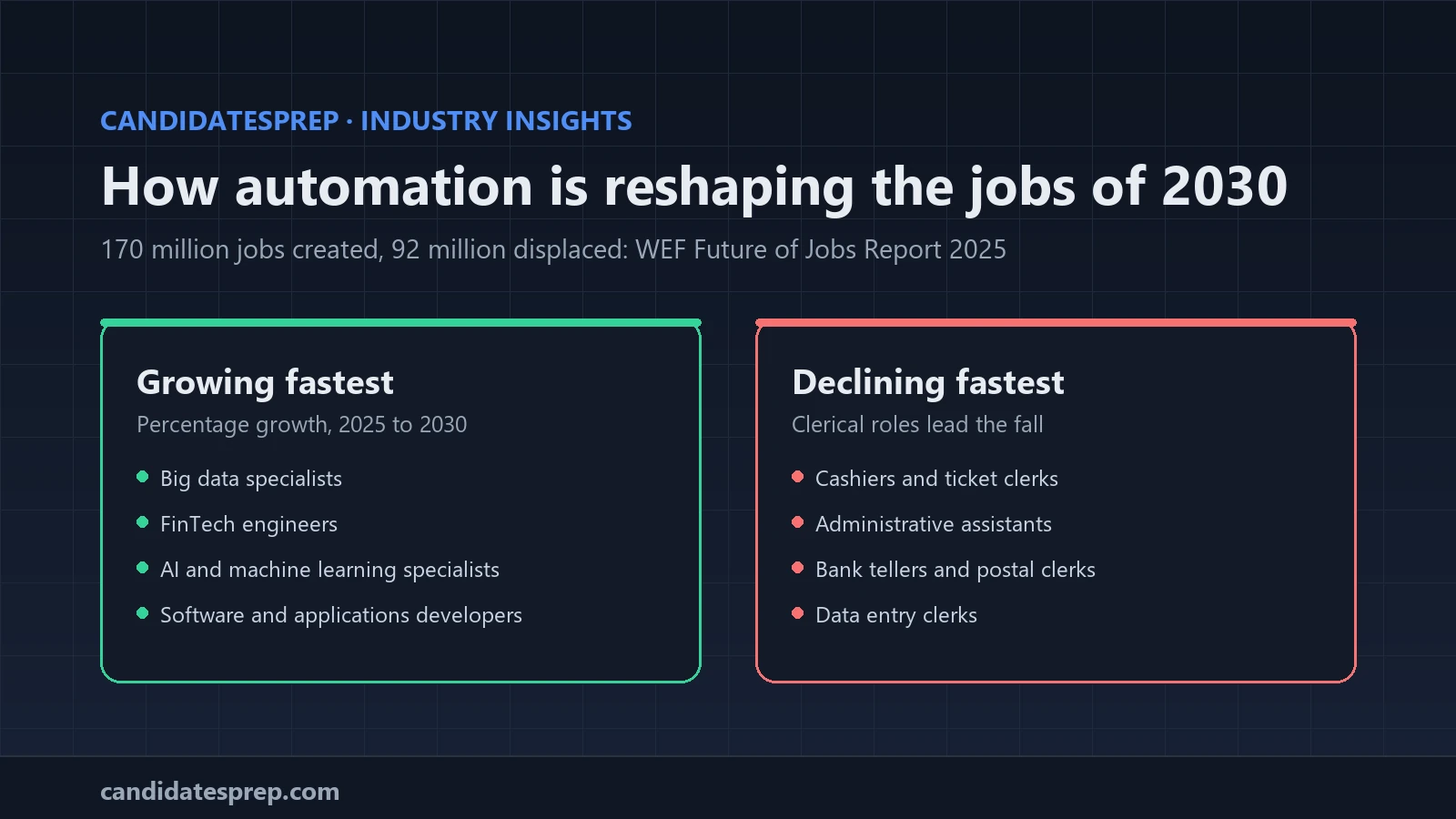
Automation is reshaping work in two ways: it creates and removes whole jobs, and it changes the tasks inside almost every job that remains. The World Economic Forum's Future of Jobs Report 2025 expects 170 million jobs to be created and 92 million displaced by 2030. Here is what is growing, what is shrinking, and how to prepare.
The numbers: created, displaced and net
The Future of Jobs Report 2025 draws on data from over 1,000 companies in 55 economies. It estimates that job creation and destruction will add up to 22% of today's jobs by 2030: 170 million new jobs, 92 million displaced, and a net gain of 78 million.
Technology is not the only driver. The green transition, demographic shifts and economic pressures all play a part. But technology is the most divergent force. Broadening digital access is expected to create 19 million jobs and displace 9 million, AI and information processing to create 11 million and displace 9 million, and robotics and autonomous systems to be the largest net displacer, with a net decline of 5 million jobs.
The OECD offers a second view. Its Employment Outlook 2023 found that, taking AI into account, occupations at highest risk of automation account for about 27% of employment. It also found little evidence so far of negative employment effects among firms that adopt AI. High risk is a warning sign, not a forecast of job losses.
The fastest-growing roles
In percentage terms, technology roles lead. The fastest-growing jobs include big data specialists, FinTech engineers, AI and machine learning specialists, and software and applications developers. Security management specialists rank in the top five, and green roles such as renewable energy engineers, environmental engineers, and autonomous and electric vehicle specialists also make the top 15.
In absolute numbers, the picture is very different. The largest growth is in frontline work: farmworkers top the list, with 35 million more jobs expected by 2030, and delivery drivers, construction workers, salespersons and food processing workers are also among the largest growers. Care and education grow strongly too, including nursing professionals, social work and counselling professionals, and secondary and university teachers.
The declining roles
Clerical and secretarial work faces the largest falls. Cashiers and ticket clerks, and administrative assistants and executive secretaries, are expected to see the biggest declines in absolute numbers. The fastest-declining roles also include postal service clerks, bank tellers and data entry clerks, along with printing workers, and accountants and auditors.
One change stands out. Graphic designers and legal secretaries appear just outside the top 10 fastest-declining roles for the first time, which the report suggests may reflect generative AI's growing capacity to do knowledge work. Routine, rules-based tasks are no longer only a factory issue.
Tasks, not whole jobs
The bigger shift is inside jobs. Employers estimate that today 47% of work tasks are done mainly by people, 22% mainly by technology and 30% by a combination of both. By 2030 they expect the three to be nearly evenly split.
That does not mean people will run out of work. The report stresses that it compares shares of tasks, not total output, and that both people and machines may be significantly more productive by 2030. The report's analysis of generative AI found that none of the more than 2,800 skills it examined showed a very high capacity to be replaced by current tools, and 69% showed a low or very low capacity. Our guide to whether AI will take your job covers which kinds of work hold their value best.
How to prepare
- Look one role along. If your role is in a shrinking group, look for growing roles that use similar strengths. Administrative experience, for example, could be a starting point for operations or data work, with targeted learning.
- Build the fastest-growing skills. The report names AI and big data, networks and cybersecurity, and technological literacy, alongside creative thinking, resilience, flexibility and agility, and curiosity and lifelong learning.
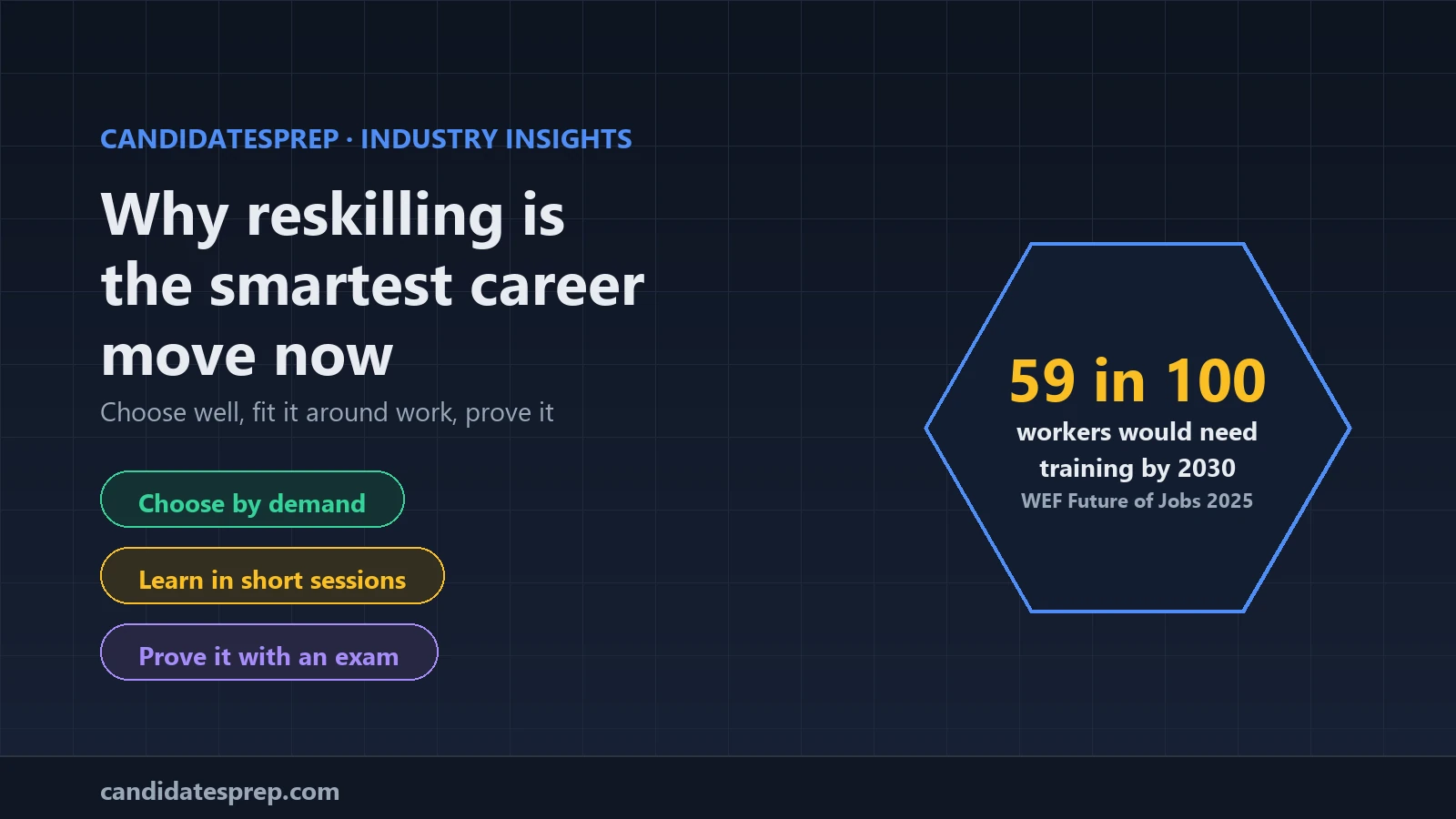
- Use your employer. 77% of employers plan to reskill and upskill their workforce to work alongside AI, and 47% plan to move staff from AI-disrupted roles into other positions. Ask what is on offer.
- Prove what you learn. A recognised certification gives an employer evidence, not just a claim.
Our guide to recession-proof skills covers which areas tend to hold up when hiring slows.
Practise under real exam conditions
If a certification is part of your plan, rehearse the exam as well as the content. On CandidatesPrep you can sit timed mocks that mirror the real exam's timer, navigation and flagging, then see your results broken down by topic, so your remaining study time goes where it is needed. Teams reskilling together can follow learning paths that unlock in order, with per-candidate readiness for the trainer.
The bottom line
Automation will create and remove millions of jobs by 2030, but its widest effect is on the tasks inside every role. Move towards growing work, build the skills that rise with technology, and prove them as you go.
Start with a timed mock on the CandidatesPrep simulator, or book a demo to reskill your team.