Exam confidence is not a mood you wait for; it is evidence you collect. You build it by practicing the way the exam will test you, watching your results improve topic by topic, and rehearsing the moments that usually rattle people. Here is how to build confidence that still holds when the timer starts.
Confidence is evidence, not positive thinking
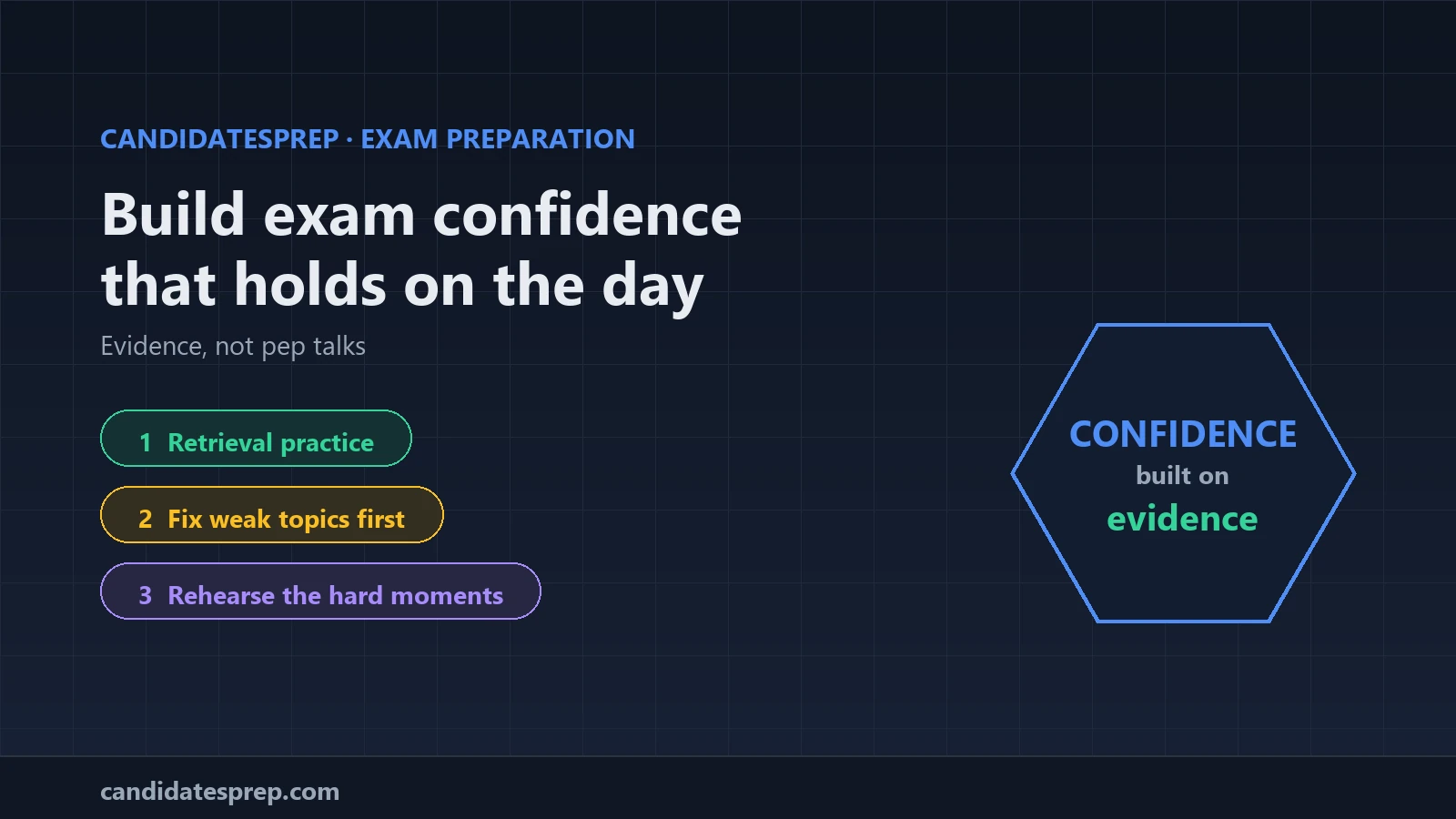
Telling yourself "I can do this" helps a little, but it rarely survives the first hard question. Confidence that lasts rests on proof: you have answered questions like these before, under similar pressure, and got most of them right. So the aim is not to feel more confident; it is to give yourself more reasons to be. Every section below is a way of collecting those reasons.
Collect proof with retrieval practice
Rereading notes feels productive because the material looks familiar, but familiarity is not the same as recall. Testing yourself is harder, and that difficulty is exactly what makes it work: each time you pull an answer out of memory, you strengthen it and you find out whether you really know it. Our guides to the testing effect and active recall explain the method in more detail. The confidence bonus is that your belief in yourself now rests on answers you produced, not pages you recognized.
Fix weak topics first
Low confidence is often vague: "I'm just bad at this exam." Break it down. After each practice set, look at your results by topic and find the two or three areas pulling your score down. Work on those, then test them again. Watching a weak topic turn into a solid one is far more convincing than any pep talk, and it stops one shaky area coloring how you feel about the whole exam.
Rehearse the hard moments
Confidence tends to collapse at predictable points: a question you cannot answer, a clock that seems to be running too fast, or a run of difficult items in a row. You can practice these just as you practice content.
- Sit full, timed mocks so the pace feels normal rather than rushed.
- Practice flagging a question you are stuck on, moving on, and coming back to it later.
- Notice where your time goes in each mock, and adjust before the real day.
Once you have recovered from a blank or a slow patch a few times in practice, it stops feeling like a disaster when it happens in the exam.
Watch what you say to yourself
Self-talk shapes how you read a hard question. "I always get these wrong" turns a tricky item into proof of failure. Swap vague, sweeping statements for specific, accurate ones based on what you have seen in practice: "I've improved on this topic in my last three mocks" or "I've handled hard questions before, so flag it and move on." Accurate is the key word. You are not trying to hype yourself up, only to stop your inner commentary being less fair than the evidence.
Beware of false confidence
Confidence built on the wrong signals can be worse than none. Feeling ready because you have read the material many times, or because you keep scoring well on questions you have already seen, can hide real gaps. Use fresh questions where you can, keep sitting timed mocks, and trust the trend across several attempts rather than one good score.
If you teach: build confidence across a cohort
Trainers can do a great deal here. Learners worry most when they cannot see their own progress, so make it visible: schedule mocks at regular points, share results by topic, and point out weak areas that have improved. Watch for anyone whose scores stall, and step in early with targeted practice rather than general reassurance. See how training institutes use CandidatesPrep to track readiness across a group.
Practice under real exam conditions
Familiarity is the foundation of confidence. On CandidatesPrep you can sit timed mocks that mirror the real exam's timer, navigation and flagging, then see your results broken down by topic, so you know exactly what is improving and what still needs work. Exam day then feels like something you have already done many times.
For the morning itself, our guide to handling exam-day nerves covers a practical routine, and our guide to managing exam stress helps if worry is getting in the way of your preparation.
The bottom line
Confidence you can rely on is built from evidence: questions answered, weak topics fixed and hard moments rehearsed. Collect that proof steadily and the feeling tends to follow.
Build your evidence with a timed mock on the CandidatesPrep simulator, or book a demo to help a whole cohort walk in ready.