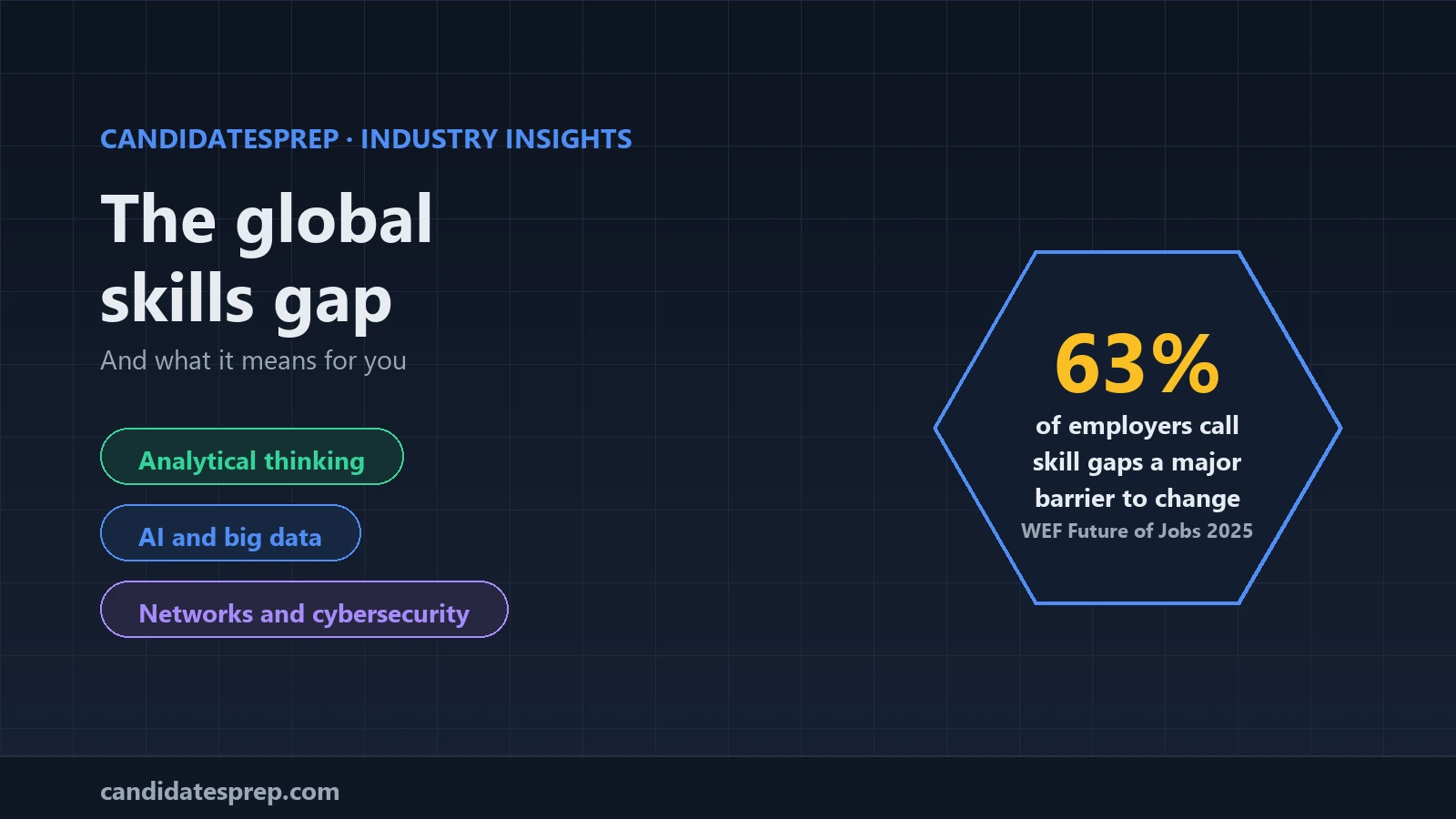
The global skills gap is the mismatch between the skills employers need and the skills workers have, and employers rank it as their biggest barrier to change. In the World Economic Forum's Future of Jobs Report 2025, 63% of employers identified skill gaps as a major barrier to business transformation between 2025 and 2030, more than any other barrier.
What the skills gap actually is
At its simplest, a skills gap is the distance between what a job needs and what the people available to do it can offer. Inside one company you can measure it person by person, and our guide to measuring employee skill gaps shows how. This post zooms out to the labour market as a whole, where the gap shapes who gets hired, who gets promoted and which roles go unfilled.
The Future of Jobs Report 2025, which draws on data from over 1,000 companies in 55 economies, found that skill gaps were the top barrier to business transformation in 52 of those 55 economies and 19 of 22 sectors. This is not a problem confined to one industry or region.
The skills employers want most
The report does not publish a single list of the hardest skills to hire, but it does show where demand is strongest and growing fastest, which is where gaps open first.
- Analytical thinking is the most sought-after core skill, considered essential by seven out of 10 companies.
- Resilience, flexibility and agility, along with leadership and social influence, complete the top three core skills.
- AI and big data, networks and cybersecurity, and technological literacy are the three fastest-growing skills to 2030.
- Creative thinking, and curiosity and lifelong learning, are rising in importance alongside them.
The pattern is a blend: technical skills that are new to many roles, paired with human skills that technology does not easily replace.
Why the gap is widening
Three forces are pulling the gap wider.
First, skills are changing fast. On average, employers expect 39% of workers' core skills to change by 2030. That is down from 44% in the 2023 edition, but it still means a large share of what you know today will need refreshing.
Second, the skills of growing jobs differ from those of declining jobs, so people cannot simply move sideways. The report names resilience, flexibility and agility, resource management and operations, quality control, programming and technological literacy as the skills that most separate the two.
Third, foundation skills are slipping. The OECD Survey of Adult Skills, published in December 2024, found that adult literacy and numeracy have largely declined or stagnated over the past decade in most OECD countries, and that on average across the countries surveyed, one in five adults can only understand simple texts or solve basic arithmetic. New technical skills are hard to build on weak foundations.
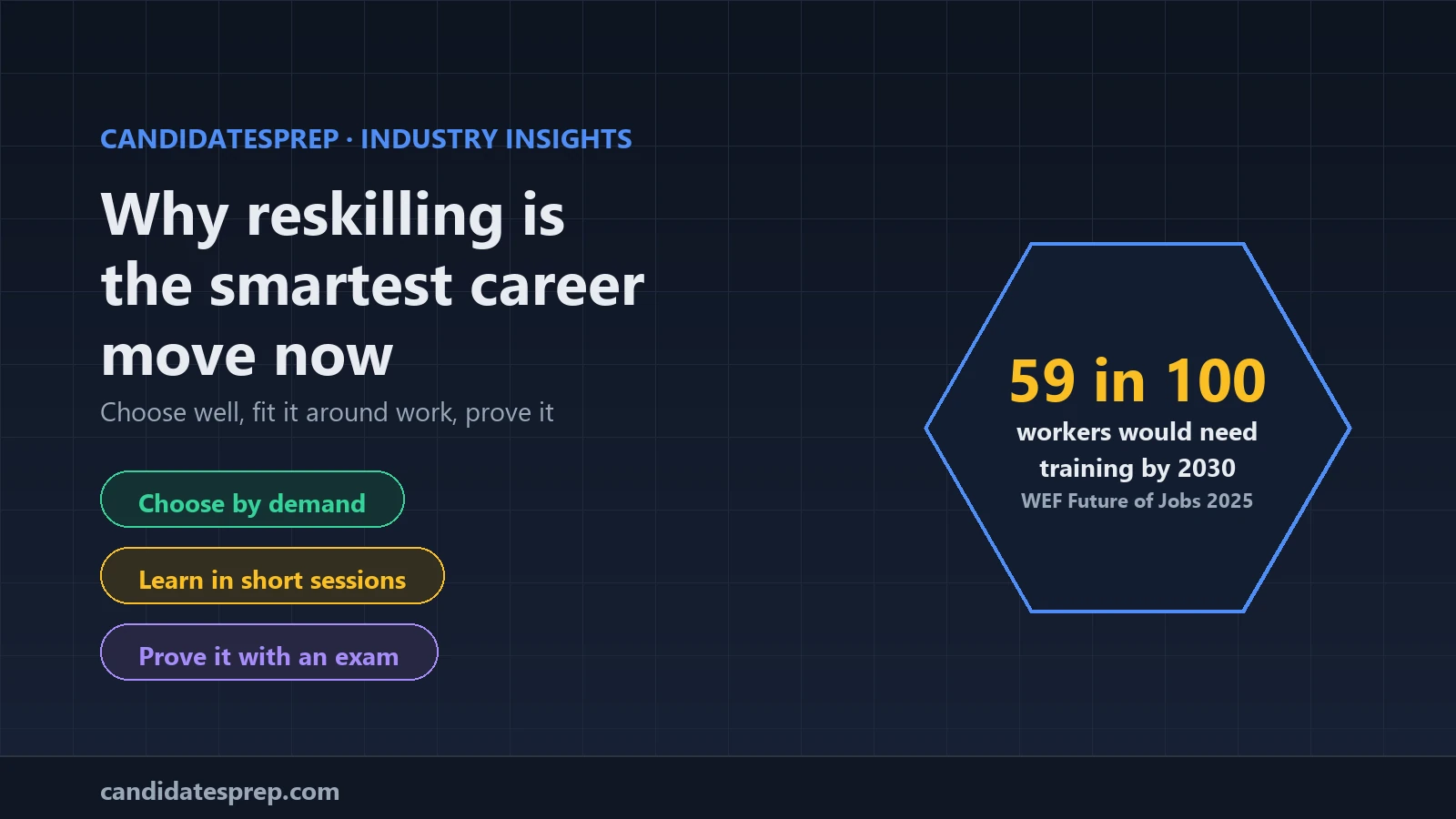
The result is a training gap as well as a skills gap. If the world's workforce were 100 people, the WEF estimates that 59 would need training by 2030, and 11 of them would be unlikely to receive it.
What it means for you
The gap is a risk if your skills sit in shrinking areas, and an opportunity if you move towards growing ones.
- Compare your current role with the fastest-growing skills above, then pick one technical and one human skill to build.
- Strengthen the basics too: data literacy and confident use of digital tools support almost everything on the list.
- Build proof as you learn. A recognised certification or a portfolio shows an employer what you can do, not just what you studied.
Our guide to recession-proof skills covers which areas tend to hold their value when the economy tightens.
What employers can do
Employers are not waiting: 85% of those surveyed plan to prioritise upskilling their workforce, and 70% expect to hire staff with new skills. Hiring alone is a crowded route, though. Only 29% of employers expect talent availability to improve by 2030, while 42% expect it to decline.
- Measure your own team's gap before you buy training, so you fix the right things.
- Build pathways that move people from declining roles into growing ones.
- Hire for demonstrated skills, not only for degrees, and test those skills directly.
- Re-test after training to check the gap has actually closed.
Practise under real exam conditions
If you are closing your own gap with a certification, preparation is where a new skill becomes proof. On CandidatesPrep you can sit timed mocks that mirror the real exam's timer, navigation and flagging, then see your results broken down by topic, so you know exactly what to study next. For organisations, courses and learning paths that unlock in order sit alongside per-candidate readiness and pass rates, which is how a corporate training LMS turns an upskilling plan into evidence.
The bottom line
The global skills gap is real, widespread and widening, driven by fast-changing skills and slipping foundations. For individuals it rewards steady, proven learning in growing areas; for employers it rewards developing people rather than relying on hiring alone.
Start closing your own gap with a timed mock on the CandidatesPrep simulator, or book a demo to plan upskilling for your team.