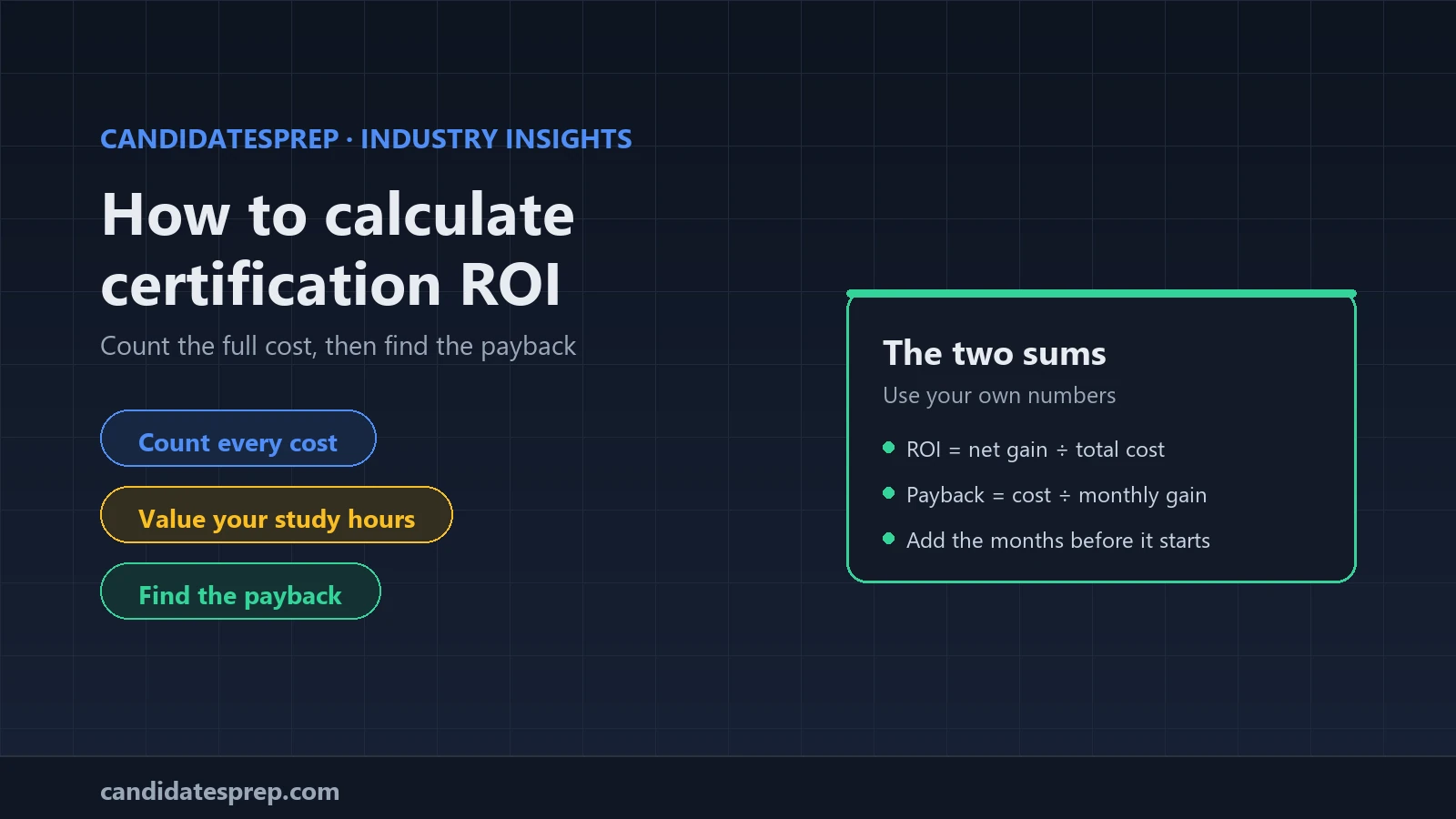
To calculate a certification's ROI, add up everything it costs you, including your study hours at your own hourly rate, and compare that with the extra pay or value it brings over a set period. A simple formula and a payback period then tell you whether the numbers work. Here is the method, step by step.
Why put numbers on it
Our honest look at whether certifications are worth it set out the questions to ask. This guide turns them into a sum you can run. The answer will never be exact, but writing the figures down exposes hidden costs and wishful thinking, and lets you compare two certifications, or a certification and a degree, on the same terms.
Step 1: count the full cost
Pick a period: three years is sensible, and matches PMI's renewal cycle for the PMP. Then list:
- Exam fee: from the issuer's own page, in your currency, including tax.
- Training: courses or classes. Some exams require it before you can apply; the PMP asks for 35 hours.
- Materials: books, practice exams and lab access.
- Study hours at your own rate: divide your annual pay by the hours you work in a year, then multiply by your planned study hours. Our guide to how many hours to study helps with the estimate.
- Renewal: PMP holders need 60 professional development units, each representing an hour, in every three-year cycle, and ISC2 charges certified members an annual maintenance fee.
Leaving your hours out makes almost any certification look like a bargain. Fees and renewal rules change, so check the issuer's pages for current details.
Step 2: list the benefits
- Pay change: a raise where you are, or a better offer elsewhere, based on evidence from your own market.
- Role access: if the certification unlocks a better-paid role, the benefit is the gap between that role's pay and yours, not the whole salary.
- Retention: it may make you harder to replace, or help your employer keep a contract that requires certified staff. This is hard to price, so note it separately rather than inventing a number.
- Time to benefit: add the months of study, the wait for an exam slot and the time until a pay review or new job. A raise that starts in 18 months is worth far less inside a three-year window than one that starts in six.
Step 3: run the formula
- ROI: total benefit over the period, minus total cost, divided by total cost, times 100.
- Payback period: total cost divided by the monthly gain, plus the months before the gain starts.
ROI tells you what you get back for each unit you put in. Payback tells you how long you are out of pocket, which matters more when money is tight.
A worked example, with made-up numbers
These figures are invented and deliberately round. They are not real fees or salaries for any certification. Over three years:
- Exam fee: 500
- Training and materials: 1,000
- 100 study hours at 20 an hour: 2,000
- Renewal fees and hours: 500
The total cost is 4,000. Suppose the certification brings a raise of 4,000 a year, starting six months after you begin studying. Over the remaining 30 months, that is 10,000.
- ROI: 10,000 minus 4,000, divided by 4,000, is 150%.
- Payback: 4,000 divided by about 333 a month is 12 months, so 18 months from the day you start studying.
Leave out the study hours and the cost halves to 2,000, cutting the payback to 12 months. That is why the hours belong in the sum.
Handle the uncertainty
Every benefit figure is a guess, so treat it like one.
- Run three cases: pessimistic, likely and optimistic. If even the pessimistic case pays back in a time you can live with, the decision is easy.
- Weight by probability: if you think there is a 50% chance of the raise, count half of it. Allow for the cost of a resit too.
- Work backwards: divide the total cost by the months you are prepared to wait. In the example, a two-year payback needs about 167 a month, or 2,000 a year. Is that realistic where you live?
- Gather local evidence: job adverts with salaries, recruiters and colleagues who hold the certification tell you more than any global average.
Practise under real exam conditions
The benefit side is largely out of your hands; the cost side is not. Ask whether your employer will fund the exam, and aim to pass first time, because a resit adds a second fee and more hours. On CandidatesPrep, timed mocks mirror the real exam's timer, navigation and flagging, and every result breaks down by topic, so your hours go where you are losing marks. Employers can check per-candidate readiness before booking exam seats; see how it works for corporate learning and development teams.
The bottom line
A certification's ROI is a simple sum once you count the full cost, including your time, and put honest, local numbers on the benefits. Run it in three cases, check the payback, and back the certifications that still look sensible in the pessimistic one.
Protect your investment with a timed mock on the CandidatesPrep simulator, or book a demo to plan certifications for a team.