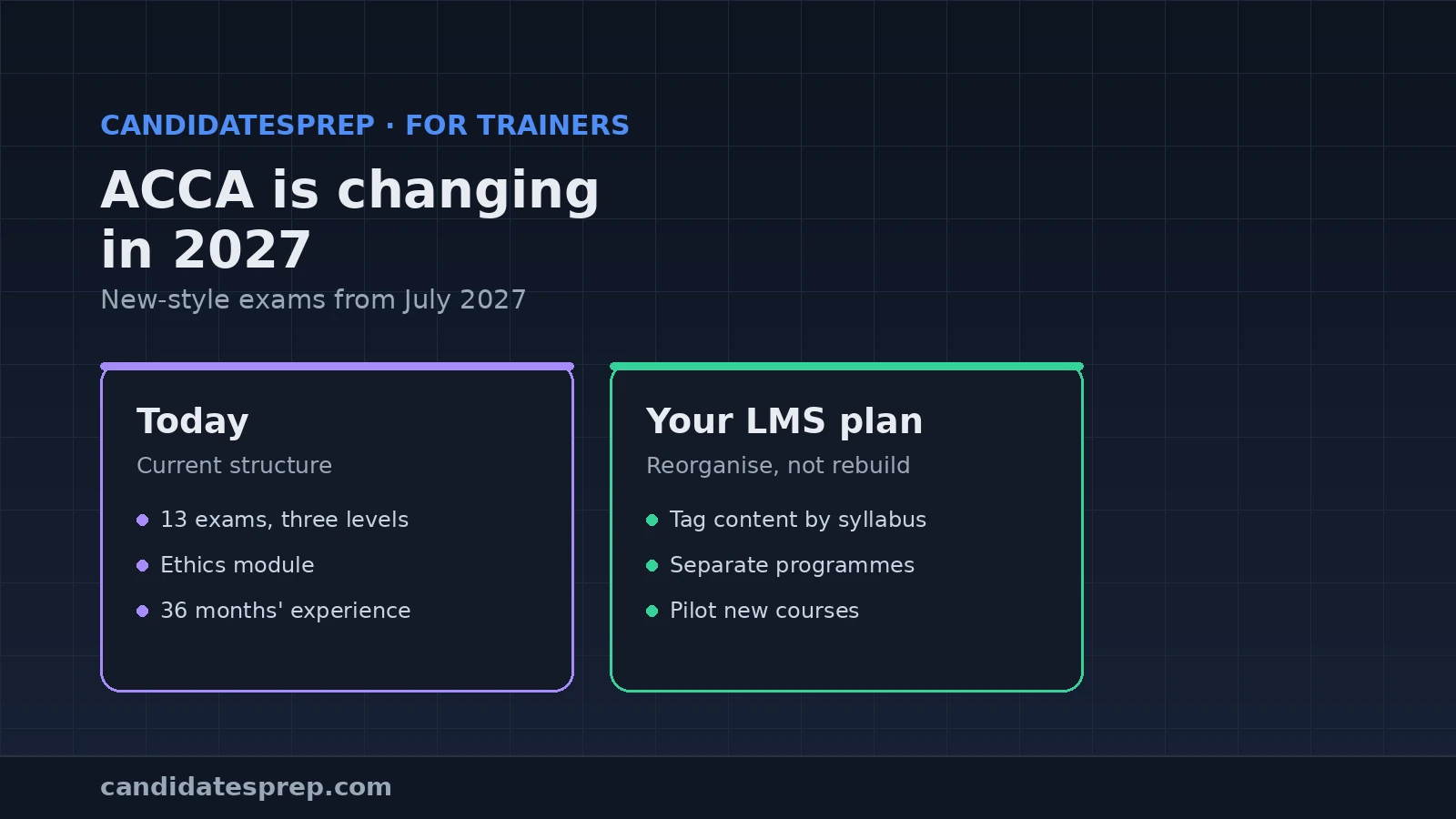
ACCA currently requires 13 exams across three levels, an Ethics and Professional Skills module and at least 36 months of practical experience, and it is restructuring the qualification with new-style exams from July 2027. Tuition providers face a period of running the old and new structures side by side. A well-organized LMS makes that far easier. Here is how.
The qualification today
According to ACCA, the current qualification has three exam levels: Applied Knowledge (three exams), Applied Skills (six exams) and Strategic Professional, where students take two Essentials, Strategic Business Reporting and Strategic Business Leader, plus two of four Options. Students also complete the Ethics and Professional Skills module and a Practical Experience Requirement of at least 36 months' relevant work experience and nine performance objectives.
What is changing
ACCA has set out its plans for the future qualification. Essential Employability Modules are due in early 2027, Foundations and Knowledge level exams start in July 2027, and Expertise and Strategic Professional level exams start in September 2027. A new Data Science Professional option exam is planned, along with a stronger focus on sustainability, AI and technology. Details may evolve, so follow ACCA's announcements closely.
Why the transition is hard for providers
Providers will be teaching students on the current structure while building courses for the new one. Content has to be mapped, restructured and tagged correctly, and students need clarity about exactly which papers they are preparing for. Managed through spreadsheets and shared drives, that quickly becomes error-prone.
How a good LMS helps
- Reusable, tagged content: tag questions and materials by exam, topic and syllabus area, so content can be reorganized into new courses without being rewritten.
- Programmes and learning paths: run separate programmes for each structure, with paths that unlock in order.
- Timed mock papers: build papers with realistic durations and pass marks, so students practice under exam conditions.
- Topic-level results: every result breaks down by topic, so tutors can target weaknesses before the real exam.
- Item analysis: identify questions that do not separate strong students from weak ones, and improve them.
- Reporting for sponsors: exportable reports help employers who fund trainees see their progress.
A practical transition plan
Audit your current bank and materials, and tag everything by syllabus area. As ACCA publishes the detail of the new structure, map those tags to the new levels and exams. Build new courses from the existing tagged library rather than starting from scratch, and pilot them with a small cohort before scaling up.
Keep students calm through the change
Students worry when a qualification changes mid-journey. Be clear about which structure each student is on, which papers they still need, and how your courses support them. Visible progress through regular timed mocks is one of the best reassurances you can offer, as our guide to building exam confidence explains.
The bottom line
The ACCA transition creates real work for tuition providers, but well-tagged content in a flexible LMS can be reorganized rather than rebuilt. Combine that with timed practice and topic-level data, and you can keep results strong through the change.
Explore our finance and accounting solutions, try the CandidatesPrep simulator, or book a demo.