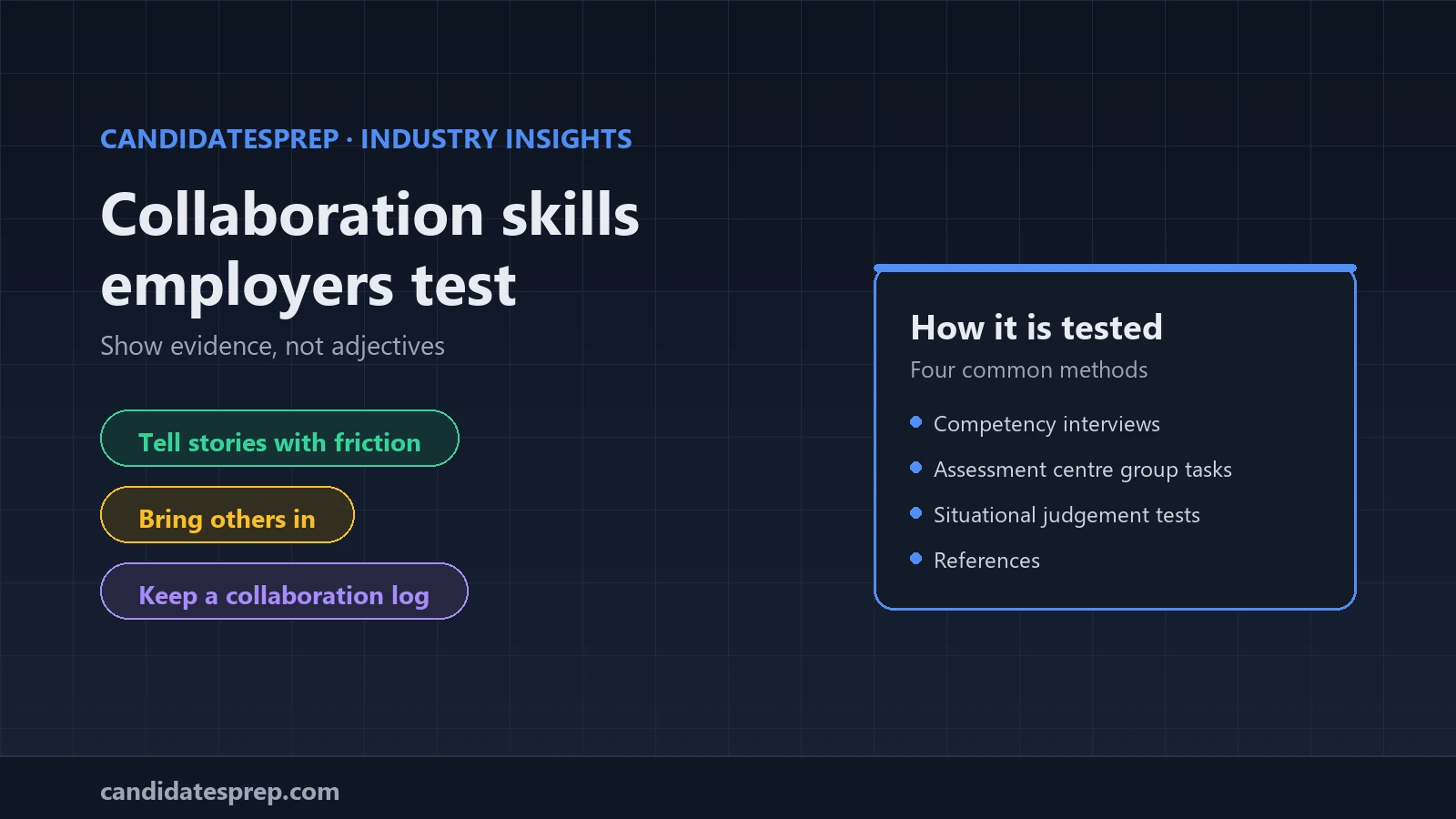
Employers rarely take "team player" on trust; they test collaboration with behavioural interview questions, group exercises, situational judgement tests and references. Each method looks for the same thing: evidence of how you have actually worked with other people. Here is what each one checks, and how to show it.
Why employers test it instead of trusting it
Almost every CV claims teamwork, so the claim alone tells a recruiter very little. In its Job Outlook 2026 Spring Update, the US-based National Association of Colleges and Employers (NACE) names the ability to work in a team, solve problems and communicate effectively as chief among the skills employers look for on students' CVs. It adds that listing them is not enough: "Employers want to see examples." Our post on why soft skills are the new hard skills covers why they matter; this one covers how they are checked.
Structured and competency interviews
Much of this testing happens in interviews built around behaviours. The UK Civil Service is a clear public example: its Success Profiles behaviours include Working Together, described as forming effective partnerships and relationships with people internally and externally. Candidates may be asked for examples of past behaviour, or how they would act in a given situation. Many private employers run competency or behavioural interviews on the same idea.
Expect questions like "Tell me about a time you disagreed with a colleague" or "Describe a project where you depended on someone else's work." Strong answers share four features:
- Your own part is clear. Say "I", not only "we", while still crediting others.
- There is some friction. A story where everyone agreed shows little; resolving a disagreement or a missed handover shows a lot.
- There is a result that someone else would recognise.
- You can say what you would do differently next time.
Our guide to communication skills for interviews and exams shows how to structure these stories.
Group exercises at assessment centres
Graduate schemes and some experienced roles add a group exercise: a small team gets a scenario or discussion topic and a fixed time to reach a view while assessors watch. Careers services such as the University of Aberdeen's point out that you are scored against set criteria, not against the other candidates, so helping the group costs you nothing.
What tends to impress assessors:
- Offering ideas early, then building on other people's.
- Bringing quieter members in and summarising where the group has got to.
- Keeping the group on task and on time.
- Disagreeing politely and with reasons, then backing the group's decision.
Talking the most is not collaborating: assessors notice who moves the group forward, not who fills the airtime.
Situational judgement tests
A situational judgement test (SJT) presents workplace scenarios and asks you to judge possible responses. The Civil Service Judgement Test, for example, asks candidates to rate four actions for each scenario on a scale from counterproductive to effective. Collaboration often surfaces in scenarios such as a colleague missing deadlines, two managers giving conflicting instructions, or a teammate struggling in silence.
Read the employer's values or behaviour framework before you start, because the scenarios reflect what the role needs. Then favour responses that tackle the problem early, involve the right people and keep the work moving, over ones that ignore it or escalate straight away.
References
References usually come last. Acas advises employers that it is best to ask for one at the final stage, and notes that an employer's reference policy can limit how much a referee includes. So a reference rarely wins you the job; it confirms what you have already shown. Choose referees who saw you work with others, ask their permission, and remind them of a project you delivered together so they have specifics to hand.
Build evidence you can show
Collaboration evidence fades quickly unless you record it. Keep a short running log at work or on your course:
- Disagreements you helped resolve, and how.
- Handovers, shared documents or processes you improved for others.
- Times you helped a colleague or classmate who was stuck.
- Work across teams, departments or sites.
- Feedback about working with others, and what you changed.
Ask for specific feedback after group projects; our guide to giving and receiving feedback shows how to make it useful. A log turns "I am a team player" into several stories you can tell in any interview.
Practise judgement questions before the real thing
Situational judgement tests and scenario-based exam questions reward practice, because weighing several plausible options is a skill in itself. On CandidatesPrep, trainers and employers can write scenario and case study questions, tag them by topic, and run them as practice mocks or timed assessments. Every result breaks down by topic, so a candidate who keeps misjudging conflict scenarios can see it. Learning and development teams use the same tools when training and assessing staff.
The bottom line
Employers test collaboration through interviews, group exercises, judgement tests and references, and every method looks for evidence rather than adjectives. Keep a record of real moments when you worked well with others, and you will have the stories ready whichever method you meet.
Practise scenario questions on the CandidatesPrep simulator, or book a demo to build judgement-based assessments for your team.