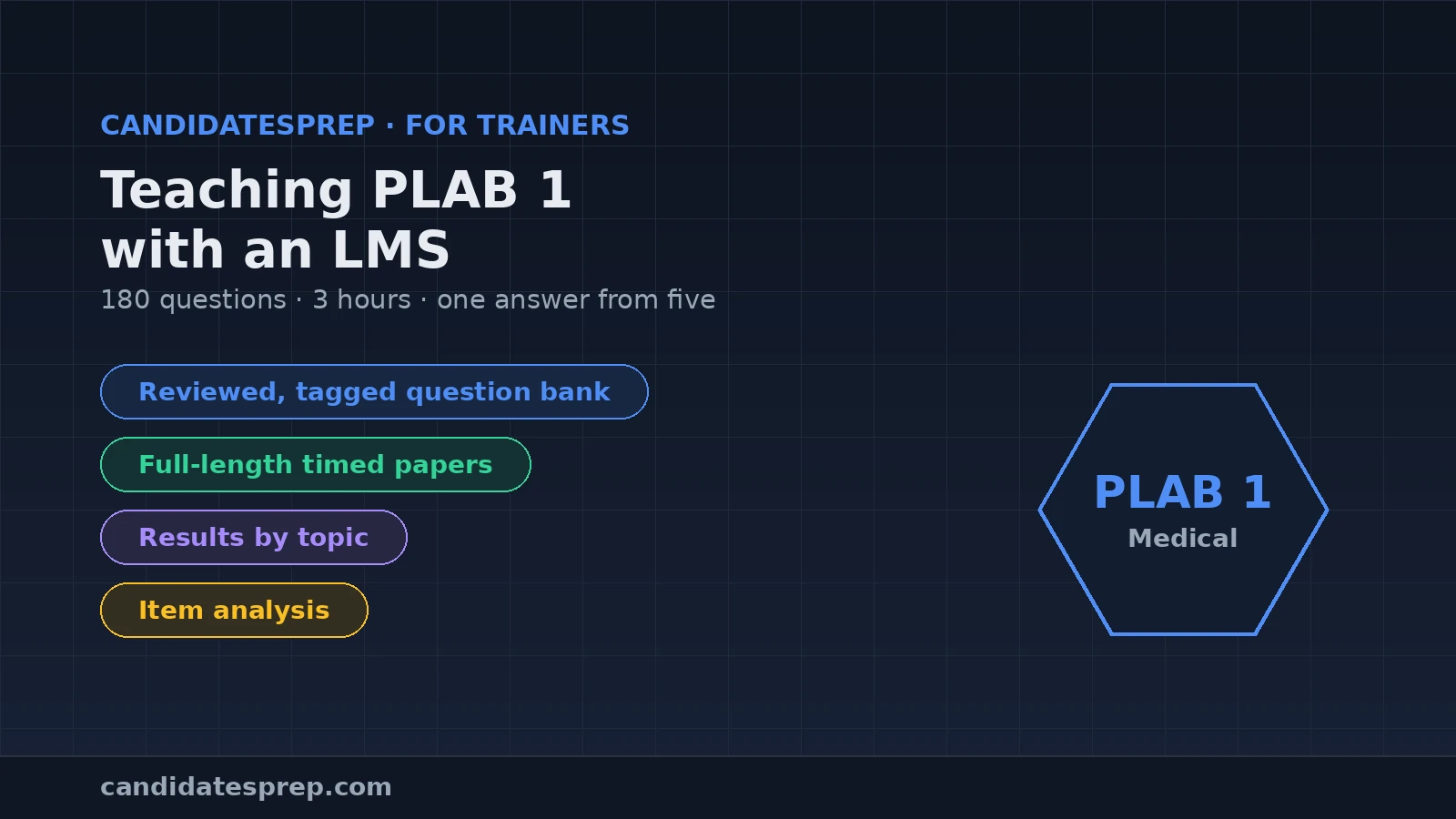
PLAB 1 is a three-hour applied knowledge test of 180 scenario-based multiple-choice questions. The academies that prepare doctors for it well run on structure: a reviewed, tagged question bank, realistic full-length papers, and clear data on who is ready. A good learning management system turns that structure from a spreadsheet headache into a routine. Here is how.
What PLAB 1 actually tests
According to the GMC, PLAB 1 has 180 multiple-choice questions to answer in three hours. Each opens with a short clinical scenario, and candidates choose one answer from five options. It assesses how doctors apply knowledge to patient care rather than how much they can recall, covering the common, important and acute conditions an F2 doctor sees, plus long-term conditions managed in primary care, all judged against current UK best practice. The GMC states that PLAB 1 complies with the Medical Licensing Assessment requirements. Always build courses from the GMC's current guidance, since details can change.
Why it is hard to teach well
- Breadth: the content spans most of medicine, so coverage gaps hide easily.
- Application: candidates must reason through scenarios, not recite facts.
- Pace: 180 questions in three hours leaves roughly a minute per question.
- UK context: many candidates trained elsewhere, so UK guidelines and practice need deliberate attention.
- Scale: academies often teach large international cohorts across several time zones.
How a good LMS makes it easier
- A tagged question bank: write or import questions once, tag each by specialty and difficulty, and reuse them across cohorts. In CandidatesPrep, questions are versioned and can pass through an approval workflow, so a clinical lead reviews new items before students see them.
- Full-length timed papers: build papers from a blueprint with the real duration, so doctors rehearse the 180-question, three-hour rhythm rather than only short quizzes. Each candidate receives a randomised paper.
- Topic-level results: every result breaks down by topic, so a tutor can see that one doctor is strong in cardiology but weak in paediatrics, and assign targeted revision.
- Item analysis: see which questions most candidates miss, or which fail to separate strong from weak candidates, and fix ambiguous stems before they mislead the next cohort.
- Cohort management: import a roster, organise trainer-led classes, and schedule sittings for a whole intake at once, with browser-based access that suits candidates spread across countries.
Write questions that mirror the real thing
The quality of the bank decides the quality of the preparation. Good PLAB-style items have a realistic vignette, one clearly best answer, and plausible distractors that reflect common clinical errors. Our guide to writing good multiple-choice questions covers the craft, and the GMC publishes sample questions that are worth studying for style.
Track readiness, not attendance
Attendance tells you who turned up; timed mocks tell you who is ready. Set full mocks at intervals through the course, watch per-candidate readiness and pass rates, and step in early with doctors whose topic scores stall. Spacing mocks through the course, rather than saving them for the end, also builds the long-term retention a broad exam rewards, as our piece on spaced repetition explains.
The bottom line
PLAB 1 rewards broad, applied knowledge delivered at pace. An LMS lets an academy build a reviewed, tagged bank once, run realistic full-length papers, and see exactly where each doctor needs help, so tutors spend their time teaching rather than administering.
See how we support medical educators on our healthcare and compliance page, try the CandidatesPrep simulator, or book a demo.